





What's Happening?
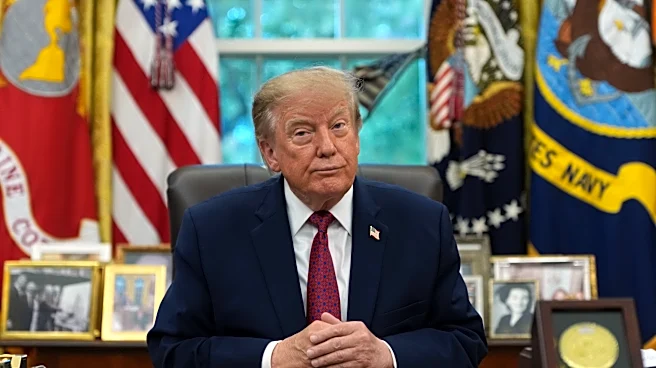
President Trump reportedly began to 'pick on' his then-Chief of Staff, Susie Wiles, shortly after her early-stage cancer diagnosis in March, according to New York Times journalist Maggie Haberman. Haberman stated on the 'Raging Moderates' podcast that
President Trump viewed Wiles' illness as a 'weakness,' which contributed to a decline in her standing. Wiles, 69, was eventually ousted earlier this month after the Republican Party experienced significant losses in the midterm elections, including losing control of Congress. It is widely believed that Wiles was blamed for these electoral defeats. Following her departure, President Trump replaced her with Stephen Miller, known for his role in immigration policy. Wiles had announced her cancer diagnosis in February but was declared cancer-free in September. Despite her recovery, the reported perception of weakness by President Trump persisted, leading to her eventual removal.
Why It's Important?
This development highlights the internal dynamics and pressures within the White House administration, particularly concerning how personal health issues may be perceived and impact professional roles at the highest levels of government. The reported treatment of Susie Wiles, a key figure in President Trump's administration, underscores a potential culture where illness is viewed as a liability rather than a challenge to be supported. This could have broader implications for how political staff manage personal health crises while serving in demanding public roles, potentially discouraging transparency or seeking necessary medical leave. Furthermore, the swift replacement of Wiles with Stephen Miller signals a shift in internal power structures and potentially a more hardline approach to policy, especially given Miller's background in aggressive immigration policies. The incident also reflects on accountability within political campaigns and administrations, as Wiles was reportedly blamed for the midterm election losses, raising questions about the distribution of responsibility for electoral outcomes.
What's Next?
Following Susie Wiles' departure, Stephen Miller's appointment as Chief of Staff is expected to bring a more ideologically aligned and potentially more aggressive approach to the White House's agenda. Miller, known as the architect of President Trump's immigration crackdown, may steer policy in a direction that aligns more closely with the 'MAGA' base. This change in leadership could lead to renewed focus on specific policy areas, particularly immigration, and potentially a more confrontational stance with the newly Democratic-controlled Congress. While Wiles is currently the only reported casualty of the midterm elections, President Trump has hinted at further cabinet changes, suggesting that more personnel shifts could be on the horizon as the administration recalibrates after the electoral setbacks. The incoming Democratic control of Congress also sets the stage for potential legislative clashes and increased oversight, with some lawmakers already indicating intentions to pursue impeachment proceedings against other cabinet members.
Beyond the Headlines
The narrative surrounding Susie Wiles' departure extends beyond typical political reshuffling, touching upon deeper ethical and cultural considerations within high-stakes political environments. The alleged 'picking on' of Wiles due to her cancer diagnosis raises questions about empathy, support, and the human cost of political service. It suggests a demanding and unforgiving work culture where vulnerability, even due to serious illness, can be perceived as a weakness leading to professional detriment. This incident could contribute to a broader discussion about workplace ethics in political offices and the psychological toll on individuals in such demanding roles. Moreover, the swift attribution of blame for electoral losses to a single individual, particularly one dealing with a health crisis, highlights the intense pressure and often unforgiving nature of political accountability, potentially obscuring systemic issues or broader campaign strategies that contribute to election outcomes.