





What's Happening?
Ryan Smith, associated with Titan, has expressed his view that the Federal Aviation Administration's (FAA) approval for one pilot to operate four drones simultaneously is too restrictive. While acknowledging the FAA's cautious approach in setting this
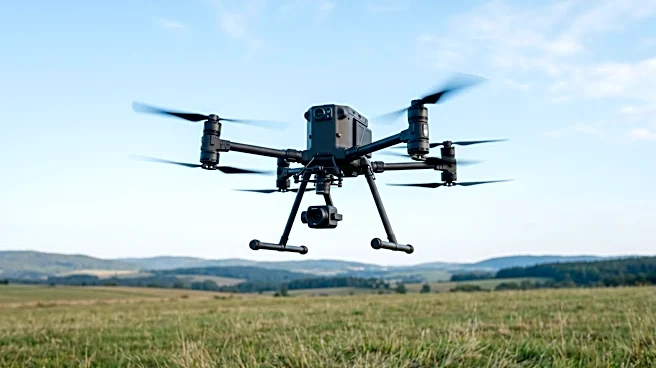
precedent, Smith believes the limit is based on a misunderstanding of how modern drone operations function. He clarifies that Titan's drones patrol autonomously, with software handling the majority of alerts by filtering out non-threats like animals or blowing debris. The pilot's primary role is to address alerts that the software cannot resolve and to take manual control only when a genuine threat is identified. Smith argues that the current limit doesn't account for the advanced automation and the support system of a Security Operations Center (SOC), where multiple pilots can assist each other, making the four-drone limit overly conservative.
Why It's Important?
This discussion between Ryan Smith and the FAA highlights a critical juncture in the integration of drone technology into U.S. airspace and security operations. The FAA's regulations directly impact the scalability and efficiency of drone-based services, particularly in sectors like security and surveillance. If Smith's assessment is accurate, an overly conservative limit could hinder technological advancement, increase operational costs for companies like Titan, and slow down the adoption of potentially more efficient and safer security solutions. The debate also underscores the challenge regulators face in keeping pace with rapid technological innovation, balancing safety concerns with the potential benefits of automation. The outcome of such regulatory decisions will significantly influence the growth and competitiveness of the U.S. drone industry and its ability to deploy advanced solutions for various applications.
What's Next?
Ryan Smith's public statement suggests a potential push for re-evaluation of the FAA's drone pilot-to-drone ratio. This could lead to further dialogue between drone technology companies, like Titan, and regulatory bodies such as the FAA. Companies may present more data on the effectiveness of their automated systems and the operational models of their Security Operations Centers to advocate for increased limits. The FAA, in turn, might consider conducting pilot programs or studies to assess the feasibility and safety of allowing a single pilot to manage a larger fleet of autonomous drones. Future regulatory updates will likely depend on advancements in drone autonomy, improved safety protocols, and a deeper understanding of human-machine interaction in complex operational environments. The industry will be watching closely for any adjustments that could unlock greater operational efficiencies.
Beyond the Headlines
The debate over drone pilot-to-drone ratios, as articulated by Ryan Smith, delves into the broader ethical and practical implications of increasing automation and artificial intelligence in critical operations. It raises questions about the optimal balance between human oversight and machine autonomy, particularly in scenarios where public safety is a concern. The concept of a 'human in the loop' versus 'human on the loop' becomes central, with Smith advocating for a model where human intelligence is leveraged for critical decision-making while automation handles routine tasks. This discussion has implications beyond drones, extending to autonomous vehicles, industrial automation, and other AI-driven systems. It forces a re-evaluation of traditional regulatory frameworks that were designed for human-centric operations and highlights the need for adaptive regulations that can accommodate rapidly evolving technological capabilities while ensuring accountability and safety.