
What's Happening?
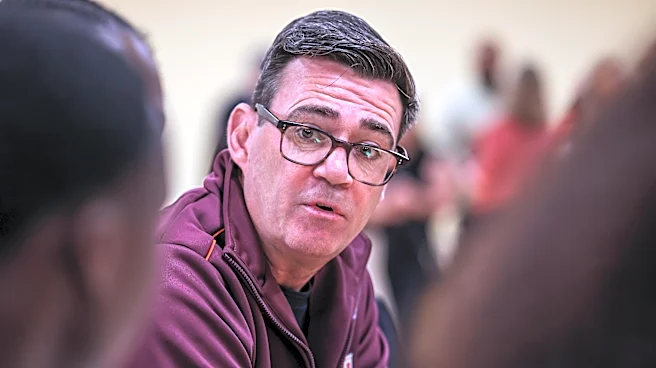
Chatham House, the Royal Institute of International Affairs, has outlined a proposed foreign policy agenda for the incoming UK government under a hypothetical Prime Minister Andy Burnham. The policy paper
suggests that due to stretched fiscal and military resources, the UK should focus on a narrow set of priorities: national security, the economy, and boosting global influence. Regarding Europe, the paper recommends completing technical agreements with the EU, deepening defense and security relationships, and coordinating responses to China's competitive threat to European industries. The institute also advises that while maintaining cordial cooperation with the United States, the UK should be prepared to diverge from US positions if they conflict with UK interests or values. Additionally, the paper highlights the importance of boosting cooperation among 'middle powers' during the UK's G20 presidency next year and calls for clarification on financing the increase of defense spending to 3.5 percent of GDP by 2035.
Why It's Important?
This proposed foreign policy agenda from a leading international affairs institute carries significant implications for the United States. The recommendation for the UK to be prepared to 'diverge with US positions that clash with UK interests or values' signals a potential shift in the traditionally close 'special relationship' between the two nations. Such a stance could lead to instances where the UK does not automatically align with US foreign policy objectives, potentially impacting transatlantic unity on critical global issues, including responses to geopolitical challenges, trade negotiations, and security alliances. For the US, this could mean a more independent UK foreign policy, requiring Washington to adapt its diplomatic strategies and potentially seek broader coalitions for international initiatives. The emphasis on 'middle powers' also suggests a UK strategy to diversify its international partnerships, which could alter the dynamics of global governance and influence, potentially reducing the relative weight of the US in certain multilateral forums.
What's Next?
While this is a proposed agenda for a hypothetical future UK government, its recommendations could influence policy discussions and strategic planning within the UK's political landscape. If a future UK government adopts such a framework, the United States would likely need to reassess its diplomatic engagement with London. This could involve more frequent and detailed consultations to ensure alignment on shared interests, or conversely, a recognition of areas where independent UK action is anticipated. The call for increased defense spending and a focus on 'middle powers' could also lead to new defense procurement decisions and shifts in international alliances, which the US would monitor closely. The UK's G20 presidency, if it prioritizes 'middle powers,' could see new initiatives that reshape global economic and political dialogues, potentially with less direct US influence than in previous G20 cycles.
Beyond the Headlines
The Chatham House paper subtly underscores a broader trend in international relations: the increasing assertiveness of traditional allies in pursuing their national interests, even when those diverge from those of major powers like the United States. This reflects a more multipolar world order where nations are less inclined to automatically follow the lead of a single dominant power. The emphasis on 'values' as a basis for potential divergence from US positions also highlights a growing ethical dimension in foreign policy, where moral considerations and national identity play a more prominent role in decision-making. This could lead to a more complex and nuanced international environment for the US, requiring greater diplomatic agility and a willingness to engage with allies on a more equal footing, acknowledging their distinct national priorities and values. It also raises questions about the future of multilateralism and the potential for new alignments based on shared interests among 'middle powers.'