



What's Happening?
Comedian and television host Bill Maher has humorously criticized the State of the Union address, calling for its end during his HBO show 'Real Time.' Maher likened the address to a king's speech, suggesting it misleads the public into believing the president
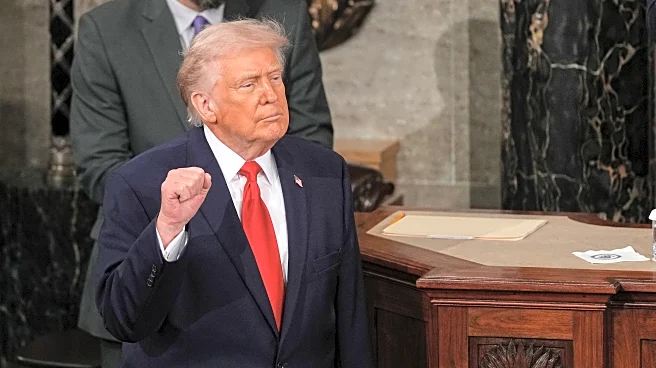
has monarchical powers. He described the event as a 'performative after-dinner speech from hell,' where members of Congress appear as 'medieval peasants.' Maher's comments were made in the context of President Trump's upcoming State of the Union address, scheduled for February 24, 2026. This critique follows a previous interaction between Maher and President Trump, where the president labeled Maher a 'jerk' after a dinner at the White House. Despite Maher's satirical remarks, the State of the Union is constitutionally mandated, requiring the president to periodically inform Congress about the nation's status.
Why It's Important?
Maher's critique of the State of the Union address highlights ongoing debates about the nature and purpose of this presidential tradition. While his comments are made in jest, they touch on broader concerns about the concentration of power in the executive branch and the performative aspects of political rituals. The State of the Union address is a significant event in U.S. politics, providing the president with a platform to outline legislative priorities and influence public opinion. Maher's remarks may resonate with those who view the address as outdated or overly ceremonial. However, the constitutional requirement ensures its continuation, reflecting the balance of power between the presidency and Congress. This discourse underscores the tension between tradition and modern political dynamics.
What's Next?
President Trump's State of the Union address is set to take place on February 24, 2026, at 9 p.m. ET. The address will be widely broadcasted across major television networks and online platforms, including the White House's YouTube page. As the event approaches, it is likely to attract significant media attention and public discourse, particularly in light of Maher's recent comments. Political analysts and commentators may further explore the implications of Maher's critique, examining the role of the State of the Union in contemporary politics. The address itself will provide insights into the administration's priorities and potential legislative initiatives for the coming year.