




What's Happening?
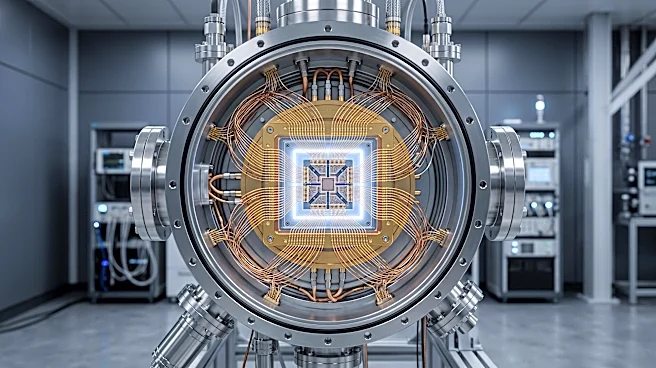
Recent quantum computing milestones, such as Google's Sycamore processor and Willow, have been presented with claims of solving computational challenges in minutes that would take classical supercomputers thousands or even septillions of years. For instance,
Google's 2019 announcement stated that its 53-qubit Sycamore processor completed a task in 200 seconds that would require IBM's Summit supercomputer 10,000 years. Similarly, the 105-qubit Willow processor reportedly completed a benchmark calculation in under five minutes, a task Google estimated would take the Oak Ridge Frontier exascale supercomputer 10 septillion years. However, these claims often involve a specific task called Random Circuit Sampling (RCS), which is designed to be an asymmetric stress test, difficult for classical architectures but native to quantum chips, and has no practical utility. Classical researchers have consistently found ways to optimize algorithms, significantly reducing the time classical supercomputers need to perform these tasks, sometimes even surpassing quantum hardware performance. For example, the 10,000-year estimate for Summit was reduced to 20 days, then to under 150 seconds by China's Sunway TaihuLight supercomputer, and later to 86.4 seconds by refined tensor network methods.
Why It's Important?
The ongoing debate surrounding quantum computing milestones highlights a critical distinction between theoretical computational speedups and practical applications. While quantum computers demonstrate impressive capabilities in specific, often synthetic, benchmarks, the real-world impact on industries and scientific research is still evolving. The rapid classical counter-attacks, where traditional supercomputers are optimized to match or exceed quantum performance on these benchmarks, underscore the continuous innovation in classical computing. This dynamic influences investment decisions, research priorities, and public perception of quantum technology. Companies and governments investing heavily in quantum computing need to discern between marketing claims and genuine scientific progress that addresses real-world problems. The focus is shifting from abstract speedup ratios to tangible applications, such as simulating nature at the atomic level for drug discovery or material science, which was Richard Feynman's original vision for quantum computing.
What's Next?
The quantum computing industry is expected to continue its pursuit of practical applications beyond synthetic benchmarks. Future developments will likely focus on achieving fault-tolerant quantum computing, which involves constructing logical qubits from many noisy physical qubits to enable continuous quantum error correction. Google's experimental proof that a physical superconducting architecture can operate measurably below the fault-tolerant threshold is a significant step in this direction. The industry will also prioritize developing quantum algorithms that can solve problems classical computers cannot efficiently handle, particularly in areas like materials science and chemistry. The emphasis will be on peer-reviewed, reproducible physical data and simulations of molecules that classical supercomputers cannot resolve. This shift will move away from uncheckable astronomical speedup claims towards verifiable scientific and engineering achievements that demonstrate genuine utility and commercial viability.
Beyond the Headlines
The narrative around quantum computing often oscillates between hype and skepticism. The 'septillion-year mirage' illustrates a broader challenge in communicating complex scientific advancements to the public and investors. While impressive numbers capture attention, they can obscure the nuanced reality of technological development. The continuous optimization of classical algorithms in response to quantum benchmarks reveals the symbiotic relationship between classical and quantum computing, where advancements in one often spur innovation in the other. This dynamic also raises ethical considerations regarding responsible communication of scientific progress, ensuring that marketing does not overshadow the rigorous scientific process. Ultimately, the long-term success of quantum computing hinges on its ability to move beyond specialized, artificial problems to address fundamental challenges that benefit humanity, such as developing new materials or understanding complex biological processes, rather than merely demonstrating theoretical speed advantages.