
What's Happening?
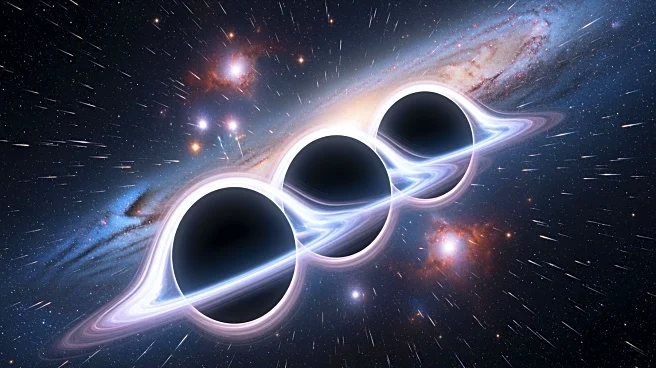
A team of astronomers has confirmed the existence of a rare cosmic configuration where three galaxies are merging, each hosting a radio-bright, actively feeding supermassive black hole. This system, known
as J1218/1219+1035, is located approximately 1.2 billion light-years away. The discovery was made through high-resolution radio imaging, providing clear evidence that black holes can feed and launch jets simultaneously during early phases of galaxy mergers. The findings, led by Dr. Emma Schwartzman of the U.S. Naval Research Laboratory, have been published in The Astrophysical Journal Letters. Initial signs of this unusual system were detected by NASA’s Wide-field Infrared Survey Explorer (WISE), which identified mid-infrared colors suggesting active galactic nuclei (AGN) in a pair of merging galaxies. Follow-up optical data confirmed the physical interaction of the galaxies, and high-frequency radio observations revealed compact synchrotron-emitting cores, indicating the presence of supermassive black holes.
Why It's Important?
The confirmation of this triple black hole system is significant as it provides a unique opportunity to study the evolutionary processes of massive galaxies and their black holes. The presence of three simultaneously active black holes supports hierarchical models of galaxy growth and suggests that black hole accretion begins well before galaxies fully coalesce. This discovery also highlights the importance of radio interferometry in identifying such systems, as traditional optical or infrared methods can be misleading due to dust obscuration. Understanding these processes is crucial for testing long-standing theories about galaxy and black hole evolution, offering insights into the life cycle of supermassive black holes and their role in shaping the universe.
What's Next?
Researchers plan to continue observing the J1218/1219+1035 system in other wavelengths, including near-infrared and X-ray, to better map the host galaxy structures and understand the energy output of each AGN. This ongoing research aims to uncover more about the dynamics of galaxy mergers and the behavior of black holes during these events. The study emphasizes the potential for discovering more triple AGN systems by combining mid-infrared selection with deep radio imaging, which could further illuminate the complex interactions between galaxies and their central black holes.