



What's Happening?
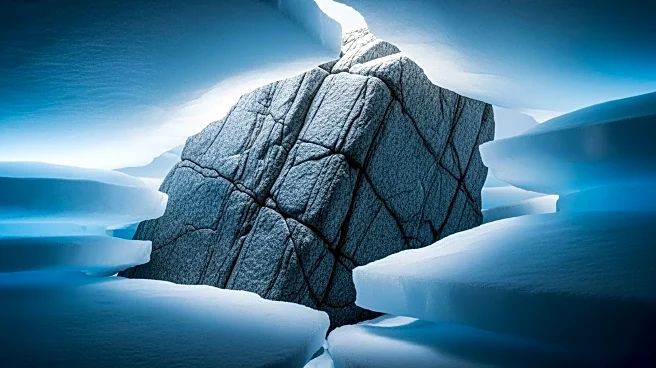
Scientists from the British Antarctic Survey have uncovered a massive granite deposit beneath the Pine Island Glacier in Antarctica. This discovery was initiated by the presence of unusual pink granite boulders found in the Hudson Mountains, which led
researchers to investigate their origins. Using aircraft equipped with gravity sensors, the team detected a hidden granite formation approximately 100 kilometers wide and seven kilometers thick, buried deep beneath the ice. This geological revelation not only solves the mystery of the pink boulders' origins but also provides new insights into the historical movement of the ice sheet and its potential future changes.
Why It's Important?
The discovery of the granite formation is significant as it enhances the understanding of Antarctica's geological history and the dynamics of its ice sheets. Pine Island Glacier is one of the fastest-melting regions in Antarctica, and understanding the underlying rock formations is crucial for predicting future ice flow and sea level rise. The granite's presence affects how the glacier moves, as it can create friction that slows down the ice or channels that accelerate its flow. This information is vital for improving models that predict sea level changes, which have direct implications for coastal communities worldwide.
What's Next?
The findings will be integrated into computer models to better predict the future behavior of the Pine Island Glacier and its impact on global sea levels. Scientists will continue to study the region to refine these models, which are essential for preparing for potential sea level rise. The research underscores the importance of understanding subglacial geology in assessing the stability of ice sheets and their contribution to global sea level changes.
Beyond the Headlines
This discovery highlights the innovative methods scientists use to study inaccessible regions like Antarctica. By combining geological dating with geophysical surveys, researchers can uncover hidden structures and gain insights into past and future environmental changes. The study also emphasizes the interconnectedness of Earth's geological and climatic systems, as ancient geological formations continue to influence present-day ice dynamics and climate patterns.