



What's Happening?
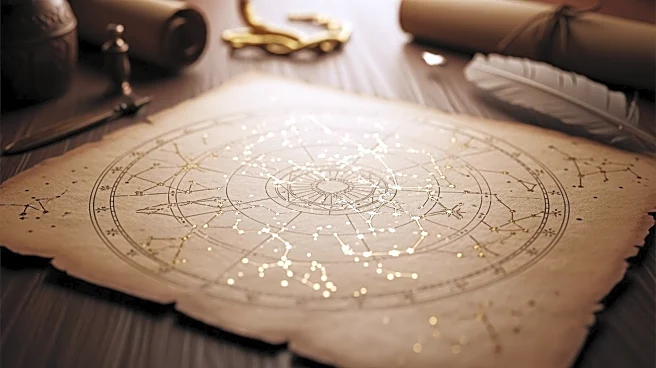
Researchers are in the process of reconstructing what is believed to be the oldest-known map of the night sky, attributed to the ancient astronomer Hipparchus. This map, previously thought lost, is being revealed through X-ray analysis of a 6th-century
manuscript known as the Codex Climaci Rescriptus. The manuscript, originally recovered from St Catherine's Monastery in Egypt, is currently being scanned at the SLAC National Accelerator Laboratory. Hipparchus, who lived from around 190 to 120 BCE, is credited as the first Western astronomer to attempt such a catalog and to determine the motions of the Sun and Moon. The manuscript pages, which were reused in the Middle Ages, contain underlying astronomical text that researchers are now able to link to Hipparchus's time. The scanning process involves using a synchrotron, a type of particle accelerator, to distinguish between different chemicals in the manuscript without damaging it.
Why It's Important?
The discovery and reconstruction of Hipparchus's star map is significant as it provides insights into the early development of scientific thought and astronomical observation. This work could answer fundamental questions about the origins of scientific inquiry over 2,000 years ago. The accuracy of the coordinates found in the manuscript, achieved without telescopic aid, highlights the advanced observational skills of ancient astronomers. This project not only sheds light on historical scientific practices but also enhances our understanding of the history of astronomy. The successful recovery of this map could influence current astronomical studies by providing a historical benchmark for celestial observations.
What's Next?
The current scanning efforts are focused on 11 pages of the manuscript, but the entire document consists of approximately 200 pages scattered worldwide. Further coordination will be necessary to gather and scan all pages to fully reconstruct the map. As more text is revealed, researchers hope to uncover additional details about the star catalog and its implications for the history of science. The ongoing analysis may prompt further studies into other ancient manuscripts that could contain hidden scientific knowledge.