







What's Happening?
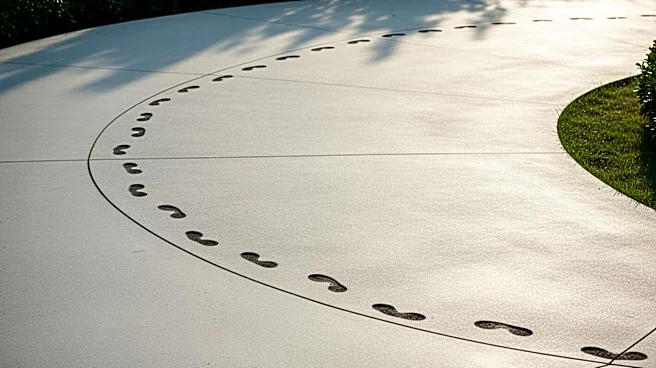
A recent study published in Nature Communications has uncovered a surprising pattern in human walking behavior, revealing a consistent bias towards turning counterclockwise. This discovery was made during research conducted by Iñaki Echeverría Huarte
and Claudio Feliciani, who studied pedestrian dynamics in Spain and Japan. The researchers observed that individuals, whether alone or in groups, tend to turn counterclockwise when changing direction. This pattern persisted across various environments, including schoolyards and busy public spaces, suggesting it is an individual rather than a collective behavior. The study involved hundreds of participants, including adults, teenagers, and children, and accounted for factors such as handedness and age. Despite initial expectations that cultural differences might influence the direction of turns, the counterclockwise bias was consistent in both Spain and Japan.
Why It's Important?
The discovery of a counterclockwise walking bias has potential implications for understanding human behavior and designing public spaces. This bias could inform the layout of areas like airports, museums, and shopping centers to improve pedestrian flow and safety. Additionally, the study highlights a possible biological basis for this behavior, which could lead to further research into human locomotion and symmetry breaking. Understanding these patterns may also have applications in emergency planning, where efficient crowd movement is crucial. The findings challenge previous assumptions about human movement and open new avenues for exploring how humans process spatial information.
What's Next?
Future research is needed to explore the underlying causes of the counterclockwise bias and its implications in more complex scenarios, such as emergency evacuations. The researchers plan to use virtual reality to further investigate this phenomenon. Additionally, the study's findings could lead to practical applications in urban planning and public safety. As the research progresses, it may reveal more about the biological and psychological factors influencing human movement, potentially impacting fields such as robotics and artificial intelligence.