









What's Happening?
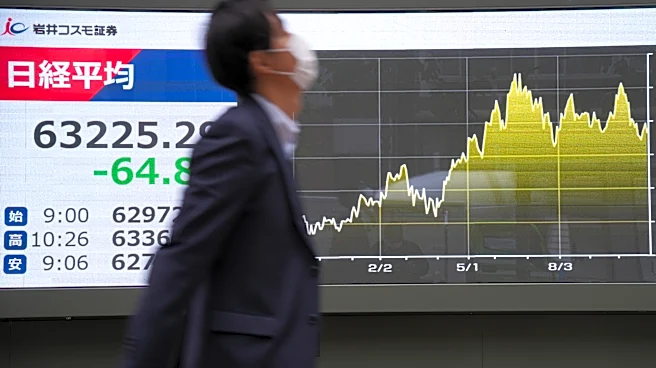
Japan's gross domestic product (GDP) is projected to fall from fourth to sixth place globally in 2027, according to the International Monetary Fund's World Economic Outlook. The estimated 2027 nominal GDP for Japan is $4.47 trillion, placing it behind
India ($4.52 trillion) and Britain ($4.49 trillion). This decline follows Japan's previous slips from second to third place behind China in 2010, and then to fourth after being overtaken by Germany in 2023. A primary factor contributing to this fall is the persistent weakness of the yen, which reduces Japan's GDP when converted into U.S. dollars. The widening yield gap with Western central banks, which began raising interest rates in 2022 while Japan maintained its ultra-low interest rate policy, accelerated the yen's depreciation. More fundamentally, Japan's economic growth rate for 2027 is projected to be below 1%, the lowest among the top six economies, and its per capita GDP has been declining since around 2020.
Why It's Important?
Japan's projected decline in global GDP ranking has significant implications for the U.S. and the broader international economic landscape. As a key economic partner and ally, Japan's economic stagnation could affect trade flows, investment opportunities, and geopolitical stability in the Indo-Pacific region. For U.S. businesses, a weaker yen makes Japanese exports more competitive, potentially impacting U.S. industries that compete with Japanese goods. Conversely, it makes U.S. exports to Japan more expensive. The underlying issues of a shrinking labor force due to an aging population and a lack of dynamic industrial turnover, as highlighted by Takayama Takeshi, senior economist at NLI Research Institute, present a cautionary tale for other developed economies, including the U.S., facing similar demographic challenges. This situation underscores the importance of innovation and industrial dynamism for sustained economic growth, areas where the U.S. currently maintains an advantage but must continue to foster.
What's Next?
Japan is expected to continue grappling with its demographic challenges and the need for structural economic reforms. The focus will likely shift towards fostering growth in potential future-oriented fields such as nursing care and healthcare, as suggested by Takayama Takeshi. Policymakers in Japan may face increasing pressure to address the yen's weakness and stimulate domestic demand. For the U.S., this trend means continued monitoring of Japan's economic health and its impact on regional and global trade. There may be opportunities for U.S. companies in sectors where Japan seeks to innovate, such as healthcare technology. The broader lesson for the U.S. is to proactively address long-term demographic shifts and ensure a dynamic environment for industrial turnover and innovation to avoid similar economic stagnation.
Beyond the Headlines
Japan's economic trajectory reveals a deeper challenge facing many developed nations: how to maintain economic vitality in the face of an aging population and declining birth rates. The persistent sluggishness, despite being a technological leader, suggests that innovation alone is not sufficient without a robust and dynamic labor force and continuous industrial reinvention. The comparison with the U.S., where industrial turnover is dynamic with new startups emerging, highlights a fundamental difference in economic adaptability. This situation raises questions about the long-term sustainability of economic models reliant on traditional manufacturing strengths and underscores the critical need for structural reforms that encourage entrepreneurship, attract skilled labor, and foster new growth industries. The ethical and societal implications of an aging population, including increased healthcare costs and a shrinking tax base, will continue to be a central theme in Japan and a growing concern for other developed nations.