



What's Happening?
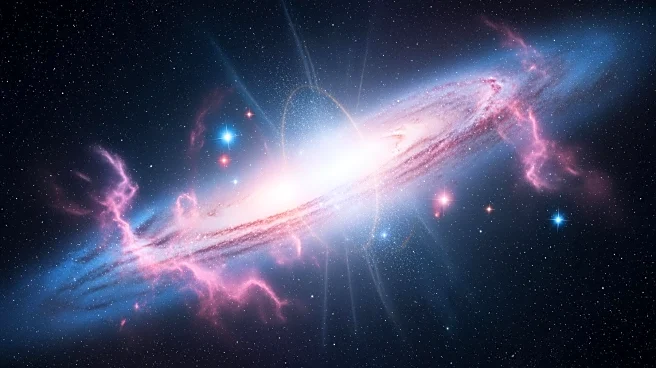
Astronomers have observed a significant merging event in the galaxy cluster RXC J0032.1+1808 using the Keck Observatory's DEIMOS multi-object spectrograph. This cluster, first identified in 1965, is undergoing a major merger, as evidenced by its bimodal
X-ray morphology. The DEIMOS data revealed two distinct peaks in the cluster's X-ray morphology, indicating the presence of two subclusters in the process of merging. The cluster is estimated to have a mass of about 1.1 quadrillion solar masses and is observed approximately 395-560 million years after the first pericenter, suggesting it is seen post-collision. The low relative velocity between the subclusters indicates that the merger is not head-on and is occurring primarily in the plane of the sky.
Why It's Important?
The observation of RXC J0032.1+1808's merging event provides a valuable opportunity to study the physics of galaxy cluster mergers and the behavior of dark matter during high-velocity collisions. Merging galaxy clusters serve as excellent laboratories for understanding galaxy evolution and cosmology. The findings could enhance knowledge about shock and cold fronts in the intracluster medium, cosmic ray acceleration, and dark matter interactions. This research contributes to the broader understanding of cosmic structures and their evolution, which is crucial for astrophysics and cosmology.
What's Next?
Further studies on RXC J0032.1+1808 could provide deeper insights into the properties of galaxy cluster mergers. Researchers may continue to analyze the cluster's dynamics and the role of dark matter in such events. The cluster's unique characteristics make it an ideal subject for ongoing and future research, potentially leading to new discoveries about the universe's large-scale structure and the forces that shape it.