



What's Happening?
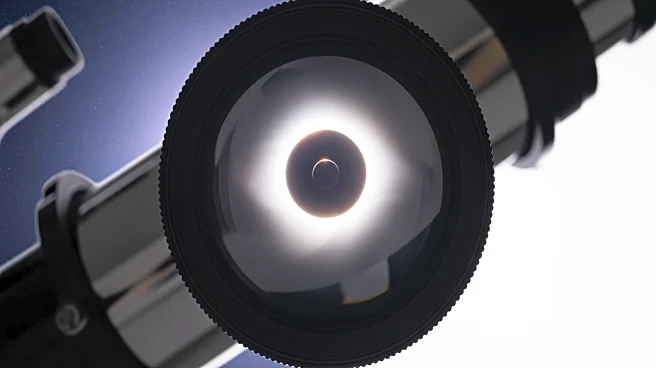
NASA's Eclipse Megamovie project has unveiled a comprehensive dataset from the April 8, 2024, total solar eclipse. This initiative involved volunteers across the United States capturing images of the Sun's corona using advanced equipment. The project has resulted
in the first-ever white-light eclipse dataset with calibration frames, offering over an hour and a half of solar corona observations. The dataset includes 52,469 photographs contributed by 143 mobile, volunteer-led observatories. These images are now accessible to researchers and the public, allowing for detailed study of solar phenomena such as jets and plumes. The data is available in the FITS format, a standard in astronomical data, and includes various levels of processing from raw to fully calibrated images. The project was a collaborative effort involving Sonoma State University, the University of California, Berkeley, and NASA's Goddard Space Flight Center, supported by numerous volunteers.
Why It's Important?
The release of this dataset is significant for both scientific research and public engagement. For researchers, the detailed observations of the solar corona provide valuable insights into solar dynamics, which can enhance understanding of solar activity and its effects on space weather. This is crucial for predicting solar events that can impact satellite operations and power grids on Earth. For the public, the project exemplifies citizen science, demonstrating how volunteer efforts can contribute to major scientific endeavors. The accessibility of the data also encourages educational opportunities and public interest in astronomy and space science.
What's Next?
The dataset's availability opens up new avenues for research into solar phenomena. Scientists can now analyze the data to study the evolution of the solar corona and related solar activities. This could lead to advancements in predicting solar storms and understanding their impact on Earth. Additionally, the success of the Eclipse Megamovie project may inspire similar citizen science initiatives, fostering greater public involvement in scientific research. As researchers delve into the data, findings may be published in scientific journals, contributing to the broader body of knowledge in solar physics.