






What's Happening?
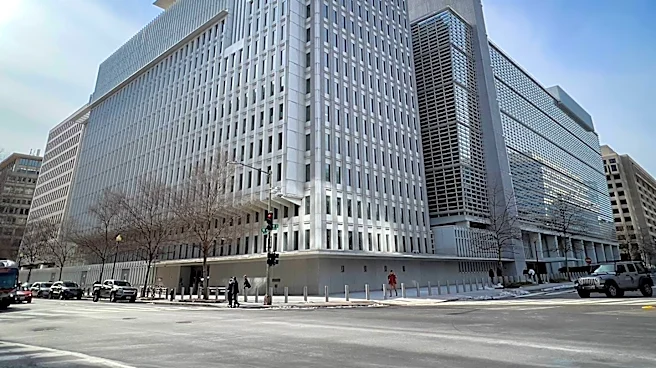
The World Bank Group (WBG) recently held a briefing on the ODI Global report titled 'Reforming MDBs: Perspectives from Client Countries.' The briefing was co-organized by EDS10 and EDS13, with Ms. Annalisa Prizzon, Principal Research Fellow in the Development
and Public Finance Program at ODI Global and lead author of the report, presenting the findings. The report, based on surveys and in-country visits with 250 government officials across 125 countries, provides crucial evidence for the WBG Evolution Roadmap and the G20 MDB reform agenda. Key findings indicate that Multilateral Development Banks (MDBs) remain highly relevant to client countries, with a growing demand for financing, particularly among IDA countries. The report also emphasizes that the effectiveness of MDBs is closely linked to a strong country presence and hands-on support.
Why It's Important?
This briefing is important because it directly informs the ongoing efforts to reform Multilateral Development Banks, including the World Bank Group itself. Understanding the perspectives of client countries is critical for ensuring that MDBs remain effective and responsive to the needs of developing nations. The growing demand for financing, especially from IDA countries (the poorest nations), highlights the essential role MDBs play in global development and poverty reduction. For the U.S., as a major contributor to the World Bank and a key player in the G20, these insights are vital for shaping its foreign aid policies and ensuring that its investments in MDBs yield tangible results. The emphasis on strong country presence and hands-on support suggests a need for MDBs to be more deeply embedded in local contexts, potentially leading to more tailored and impactful development programs.
What's Next?
The insights from the ODI Global report are expected to directly influence the World Bank Group's ongoing Evolution Roadmap and the broader G20 MDB reform agenda. The discussion following the presentation, which involved Executive Director offices, reflected a strong interest in integrating client country perspectives into the reform process. This suggests that future reforms may prioritize increased financing for IDA countries, enhanced country-level engagement, and more practical, on-the-ground support. The WBG will likely use these findings to refine its operational strategies, improve its responsiveness to client needs, and strengthen its overall effectiveness in promoting sustainable development globally. Continued dialogue and collaboration with client countries will be essential to ensure that the reforms are well-received and successfully implemented.
Beyond the Headlines
The report's findings underscore a fundamental tension in international development: the balance between global policy frameworks and local realities. While MDBs operate on a global scale, their effectiveness is ultimately determined by their ability to address specific challenges in diverse national contexts. The call for 'strong country presence and hands-on support' suggests a move away from a one-size-fits-all approach towards more localized and adaptive strategies. This could lead to a re-evaluation of how MDBs structure their operations, staff their country offices, and engage with local stakeholders. Ethically, it reinforces the principle of 'localization' in development, ensuring that the voices and priorities of those directly affected by development projects are central to decision-making. This shift could foster greater ownership of development outcomes by client countries and enhance the legitimacy and impact of MDB interventions.