
What's Happening?
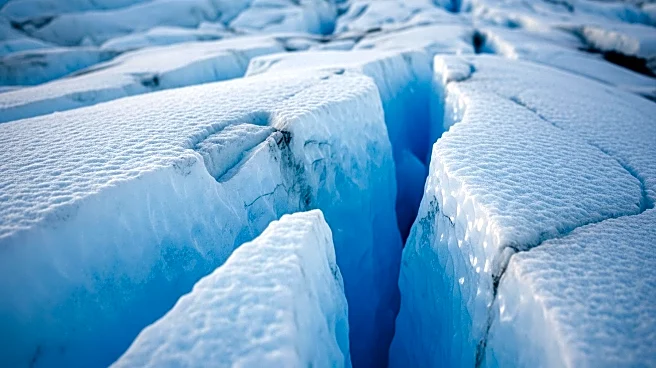
A Greenland glacier is exhibiting unusual cracking patterns, providing scientists with real-time data on glacial dynamics. Since 1995, a lake formed on the 79°N Glacier has experienced repeated drainage
events, leading to the formation of extensive fracture fields and vertical channels known as moulins. These events have increased in frequency, with significant implications for the glacier's stability. Researchers are using satellite and airborne data to study these changes, which are linked to rising atmospheric temperatures. The findings are crucial for understanding how glaciers respond to climate change and the potential impact on sea levels.
Why It's Important?
The study of the Greenland glacier's cracking patterns is vital for improving ice sheet models and predicting future changes in the Arctic. As atmospheric temperatures rise, understanding the behavior of glaciers becomes increasingly important for assessing the impact of climate change on global sea levels. The research provides valuable data on how glaciers respond to stress and the role of meltwater in glacial dynamics. These insights are critical for policymakers and scientists working to mitigate the effects of climate change and protect vulnerable ecosystems.