





What's Happening?
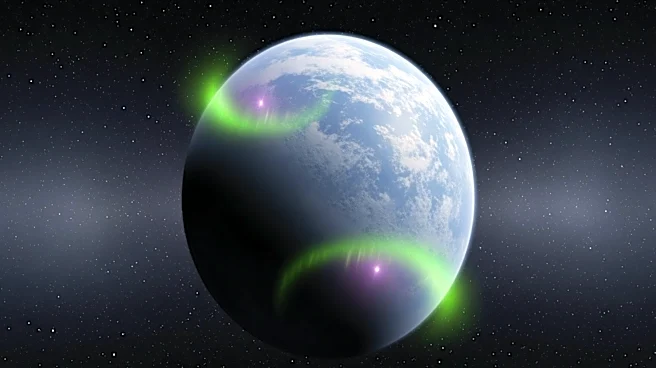
Astronomers have used the James Webb Space Telescope (JWST) to capture the first images of auroras on Uranus. The observations revealed that Uranus' magnetic pole is tilted by 60 degrees, causing its auroras to sweep across the planet's surface in complex
patterns. The planet's upper atmosphere is filled with ions, similar to the processes that create auroras on Earth. This discovery provides new insights into the atmospheric and magnetic properties of Uranus, expanding our understanding of the planet's unique characteristics.
Why It's Important?
The ability to observe auroras on Uranus marks a significant advancement in planetary science, offering a deeper understanding of the planet's magnetic field and atmospheric dynamics. This discovery could lead to new theories about the formation and evolution of Uranus and other ice giants in our solar system. The findings also demonstrate the capabilities of the JWST in studying distant celestial bodies, paving the way for future explorations and discoveries in space science.