






What's Happening?
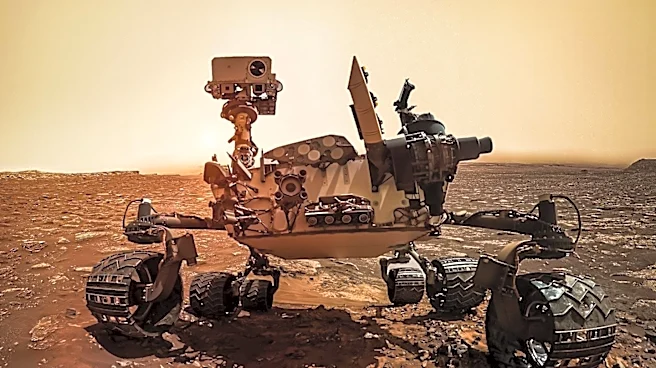
NASA's Curiosity rover has embarked on a new exploration phase on Mars, targeting a smooth-looking area that revealed unexpected geological features upon closer inspection. The rover, part of the Mars Science Laboratory mission, captured images of diverse
polygons, veins, and textures that were not visible in orbital images. The team, led by Professor Susanne P. Schwenzer, planned a series of investigations using various instruments to analyze the Martian surface. The findings include detailed imaging and chemical analysis of the terrain, which could provide insights into Mars' geological history.
Why It's Important?
The discovery of these geological features is significant for understanding Mars' past environmental conditions. The data collected by Curiosity could offer clues about the planet's history, including the presence of water and potential habitability. This mission continues to advance our knowledge of Mars, contributing to broader efforts in planetary science and exploration. The findings may also inform future missions, including those aimed at human exploration, by identifying areas of scientific interest and potential resources.
What's Next?
Curiosity will continue its exploration, focusing on high-resolution imaging and chemical analysis of the newly discovered features. The team plans to conduct further studies to understand the formation and composition of the polygons and veins. These efforts will be crucial in piecing together the planet's geological history. The mission's progress will be closely monitored by the scientific community, with potential implications for future Mars exploration strategies.