






What's Happening?
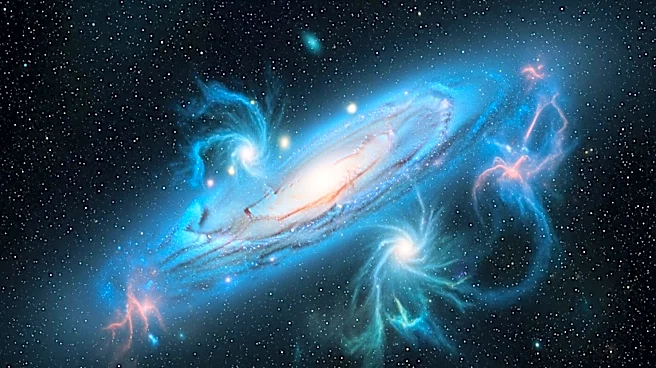
Astronomers have identified a significant reservoir of cold molecular gas in the galaxy REBELS-25, which existed when the universe was only about 700 million years old. This discovery was made using the U.S. National Science Foundation's Very Large Array
(NSF VLA) and the Atacama Large Millimeter/submillimeter Array (ALMA). The presence of this gas, which is the primary fuel for star formation, provides direct evidence of the conditions that allowed early galaxies to grow rapidly. The research, published in the Monthly Notices of the Royal Astronomical Society, highlights the detection of faint radio emissions from carbon monoxide molecules, marking the most distant low-energy CO detection to date. This finding offers new insights into the mass assembly of galaxies during the universe's first billion years.
Why It's Important?
The discovery of cold molecular gas in REBELS-25 is crucial for understanding how early galaxies formed and evolved. This gas is essential for star formation, and its presence in such an early galaxy suggests that some galaxies were already primed for rapid growth shortly after the Big Bang. This research provides a direct measurement of the star-forming material, rather than relying on indirect inferences, offering a clearer picture of the processes that drove early galaxy formation. The findings also demonstrate the capabilities of current astronomical technology and foreshadow the potential of future instruments like the Next-Generation Very Large Array (ngVLA), which will enhance the study of early galaxies.
What's Next?
The success of this study sets the stage for future observations with the ngVLA, which will be able to detect cool molecular gas in a larger sample of early galaxies. This will allow astronomers to map how galaxies gathered fuel and grew during the cosmic dawn. The ngVLA, with its enhanced capabilities, will provide a more comprehensive understanding of galaxy formation and evolution, potentially uncovering even fainter and more distant systems than REBELS-25. This ongoing research will be crucial for piecing together the history of the universe's earliest structures.