



What's Happening?
Prime Minister Shri Narendra Modi is set to inaugurate the Bharat Renewable Energy Summit & Expo 2026 (Bharat RE 2026) on November 2, 2026, at Bharat Mandapam, New Delhi. This four-day event, running until November 5, 2026, will serve as a global platform
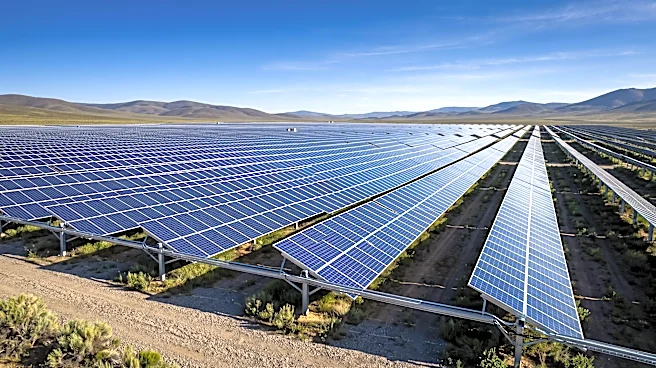
for engagement across the clean energy sector. The summit, themed 'Invest. Innovate. Inspire.', aims to attract participants from over 130 countries, including more than 40 Ministers, policymakers, investors, financial institutions, and industry leaders. Bharat RE 2026 will feature plenary sessions, ministerial discussions, CEO roundtables, and country and state sessions to foster investment, partnerships, and project development. Concurrently, the 9th Session of the International Solar Alliance (ISA) Assembly and the 4th International Conference on Green Hydrogen (ICGH) will also take place, focusing on international cooperation in solar energy and green hydrogen technologies, respectively. The Expo will showcase over 400 exhibitors presenting advanced technologies, Indian manufacturing capabilities, and clean energy solutions in solar, wind, green hydrogen, and energy storage.
Why It's Important?
This summit is crucial for accelerating the global transition to clean energy, particularly by mobilizing international capital and fostering technology partnerships. India's ambitious targets, including achieving 50% of its energy from renewable sources by 2030 and net-zero commitments by 2070, underscore the significance of such events. The country aims to attract approximately $220 billion in investment in the renewable energy sector between 2027 and 2030. The discussions will address critical challenges such as integrating a growing share of renewable energy into electricity grids, expanding storage capacity, strengthening transmission networks, and developing domestic manufacturing capabilities. The participation of numerous countries and regional blocs, including Australia, Denmark, the European Union, France, Germany, the Netherlands, Norway, Sweden, and the United Kingdom as Country Partners, highlights the international collaborative effort required to achieve global clean energy goals. The event also provides a platform for 13 Indian states and Union Territories to showcase their renewable energy potential and investment opportunities.
What's Next?
Following the inauguration by Prime Minister Shri Narendra Modi, the four-day summit will proceed with a comprehensive agenda designed to facilitate global engagement in clean energy. The concurrent ISA Assembly and ICGH will advance international cooperation in solar energy and green hydrogen, respectively, with a focus on finance, institutional capacity, and technology scale-up. The outcomes of these discussions are expected to lead to new investment commitments, technology transfer agreements, and collaborative projects aimed at accelerating clean energy deployment worldwide. The event will also provide a platform for India to share its experiences with initiatives like PM-KUSUM and PM Surya Ghar, potentially inspiring similar programs in other countries, especially in emerging economies and the Global South. The insights gained and partnerships formed during Bharat RE 2026 are anticipated to shape future policies and investment strategies in the global renewable energy landscape.
Beyond the Headlines
The Bharat Renewable Energy Summit & Expo 2026 represents more than just a gathering of industry leaders; it signifies a concerted global effort to address climate change and achieve energy security through sustainable means. The emphasis on 'Invest. Innovate. Inspire.' reflects a holistic approach to clean energy development, recognizing that financial investment, technological advancement, and inspirational leadership are all vital components. The integration of the ISA Assembly and ICGH within the summit underscores the interconnectedness of various clean energy technologies and the need for a multi-faceted strategy. This event could catalyze a shift in global energy paradigms, promoting a more equitable distribution of clean energy resources and technologies, particularly for developing nations. The focus on domestic manufacturing capabilities also highlights a broader trend towards energy independence and resilience, reducing reliance on volatile fossil fuel markets and fostering local economic growth.