
What's Happening?
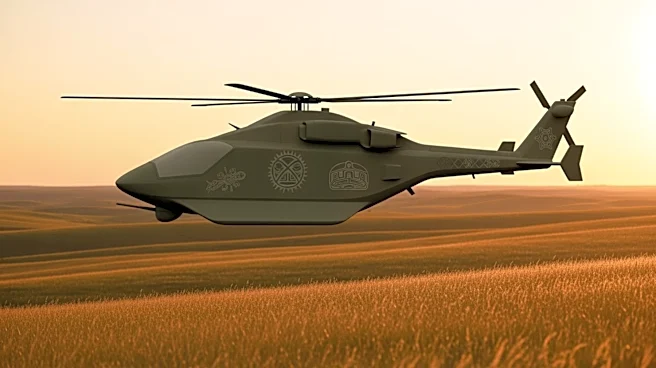
The U.S. Army has officially named its new assault aircraft the MV-75 Cheyenne II, a nod to the Plains warrior history. This announcement was made during the Army Aviation Association of America's annual
summit in Nashville, Tennessee, with members of the Northern Cheyenne Tribe and the Cheyenne and Arapaho Tribes present. The MV-75, developed by Bell Textron, is set to replace the UH-60 Black Hawk as the Army's primary assault helicopter. The aircraft combines the vertical agility of a helicopter with the speed and range of a fixed-wing aircraft, allowing it to fly twice as fast and far as the current fleet. The naming continues a tradition of using Native American names for military helicopters, a practice dating back to 1947.
Why It's Important?
The introduction of the MV-75 Cheyenne II represents a significant advancement in military aviation technology, enhancing the U.S. Army's operational capabilities. The new helicopter's extended range and speed are crucial for future military operations, particularly in the Indo-Pacific region, where the 'tyranny of distance' poses logistical challenges. The naming of the aircraft also reflects a continued tradition of honoring Native American tribes, which holds cultural significance and fosters a sense of respect and recognition for their historical contributions. The MV-75 is expected to play a pivotal role in reshaping battlefield strategies and expanding the Army's reach in various combat scenarios.
What's Next?
The Army plans to replace a substantial portion of its Black Hawk fleet with the Cheyenne II over the coming decades. The 101st Combat Aviation Brigade at Fort Campbell, Kentucky, will be the first to field the new aircraft, with deliveries expected to begin in 2027. The transition to the MV-75 is anticipated to fundamentally change air assault operations, offering new tactical advantages. As the Army integrates this new technology, it will likely conduct extensive training and operational evaluations to maximize the aircraft's capabilities and ensure seamless integration into existing military frameworks.