
What's Happening?
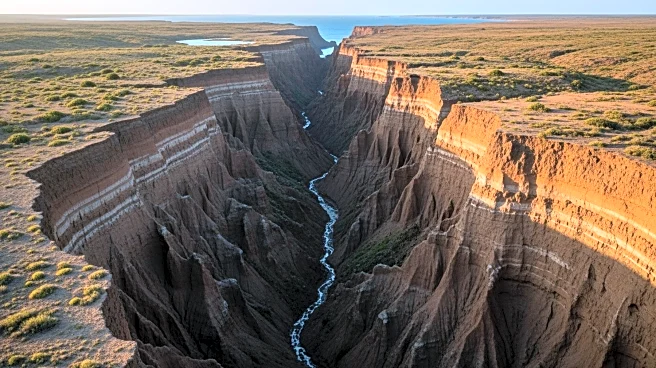
A significant geological event is unfolding in East Africa, where the continent is splitting along the East African Rift System. This tectonic divergence is occurring faster than previously anticipated,
potentially leading to the formation of a new ocean between eastern and western Africa over the next 5 to 10 million years. Recent data from the University of Rochester, NASA, and the U.S. Geological Survey indicate that the region's crust is thinning and fracturing, with early-stage oceanic crust already forming in some areas. This process is driven by the interaction of the Nubian, Somalian, and Arabian tectonic plates, particularly at the Afar Triple Junction in Ethiopia. The rift's widening has been confirmed by satellite imagery, which shows visible changes in the landscape.
Why It's Important?
The accelerated rifting in East Africa has significant implications for the region's infrastructure and economy. As the rift crosses densely populated areas, it increases the risk of seismic and volcanic activity, posing challenges for roads, pipelines, and urban development. Additionally, the tectonic activity presents opportunities for geothermal energy exploitation, which countries like Kenya are beginning to harness as a renewable energy source. This geological phenomenon also provides a unique opportunity for scientists to study continental breakup processes in real-time, offering insights into historical tectonic events such as the formation of the Atlantic Ocean.
What's Next?
As the rift continues to widen, governments in the region will need to address the infrastructural and economic challenges posed by the geological changes. There may be increased investment in monitoring and mitigating seismic risks, as well as in developing geothermal energy resources. The scientific community will likely continue to focus on this region to gain a deeper understanding of tectonic processes and their implications for continental drift and ocean formation.