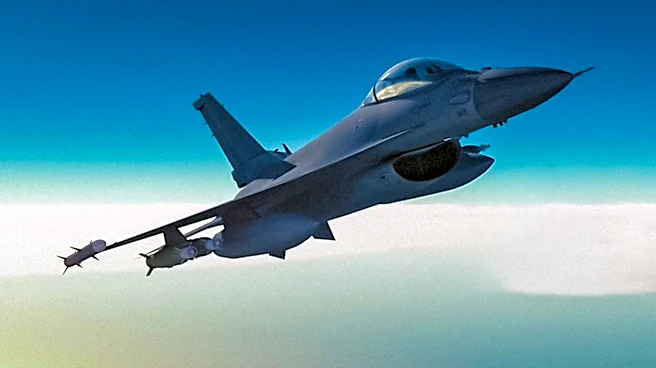









What's Happening?
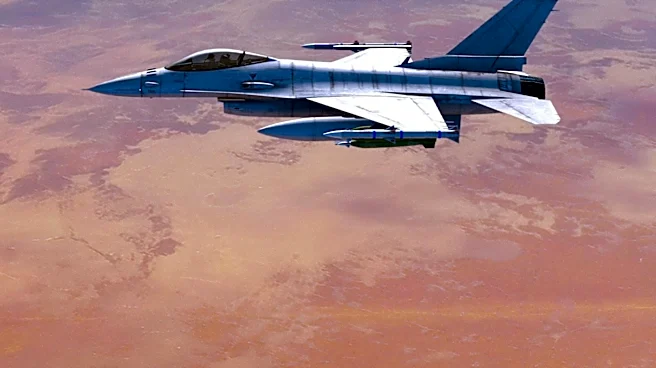
The F-16 Fighting Falcon continues to be a widely operated fighter jet globally, serving as a workhorse for the U.S. Air Force and numerous international air forces. Despite the emergence of 5th-generation aircraft like the F-22 Raptor and F-35 Lightning
II, the F-16, alongside the F-15 Eagle, maintains its relevance through continuous upgrades. The F-16 is recognized for its versatility and affordability, making it a popular choice for many nations. Its combat record spans decades and numerous conflicts, highlighting its adaptability and survivability. The discussion around the 'best' fighter plane often depends on specific mission requirements, budget constraints, and a nation's strategic needs, with the F-16 consistently ranking high in terms of widespread use and operational effectiveness.
Why It's Important?
The enduring presence and continued upgrades of the F-16 Fighting Falcon are significant for U.S. defense strategy and international military cooperation. As a primary export for the U.S. defense industry, the F-16's sustained demand supports American manufacturing and technological leadership in aerospace. Its widespread adoption by allied nations fosters interoperability and strengthens military alliances, which is crucial for joint operations and global security initiatives. The F-16's balance of performance, cost-effectiveness, and upgradeability allows countries with varying defense budgets to maintain modern air capabilities. This also impacts the competitive landscape for newer, more expensive 5th-generation fighters, as the F-16 offers a viable and proven alternative for many operational roles, influencing procurement decisions and defense spending worldwide.
What's Next?
The future of the F-16 Fighting Falcon will likely involve further modernization efforts to integrate advanced avionics, weapon systems, and electronic warfare capabilities, ensuring its relevance against emerging threats. Discussions about F-16 upgrades for countries like Ukraine indicate a continued commitment to enhancing its operational lifespan and effectiveness in contemporary conflicts. As 6th-generation fighter jet programs, such as the US Next Generation Air Dominance (NGAD) initiative, progress towards service entry around the 2030s, the F-16 will continue to serve as a foundational component of air forces globally, potentially transitioning to roles that complement more advanced stealth platforms. Its role in air policing and precision strike missions is expected to persist, supported by ongoing maintenance and technological enhancements.
Beyond the Headlines
The sustained prominence of the F-16 Fighting Falcon highlights a broader trend in military aviation: the strategic value of proven, adaptable platforms alongside cutting-edge technology. While 5th-generation fighters offer unparalleled stealth and sensor fusion, their high unit costs and operational expenses limit widespread adoption. The F-16 represents a pragmatic solution, offering robust capabilities at a more accessible price point, which has significant implications for global power dynamics and arms trade. This dynamic underscores the ethical considerations of defense spending, where nations must balance advanced capabilities with economic realities and the need for broad-based security. The F-16's legacy also reflects the continuous evolution of aerospace engineering, demonstrating how foundational designs can be iteratively improved to meet evolving military requirements, influencing future aircraft development and procurement strategies.