



What's Happening?
A Government Accountability Office (GAO) report indicates that federal agencies are facing significant challenges in accurately tracking office space utilization, which is impeding efforts to reduce costs associated with vacant properties. The report found
that the Department of the Interior only reported the number of employees assigned to an office, not their actual attendance. Similarly, the Department of Homeland Security failed to provide occupancy data for nearly 700 agency spaces due to limitations in their badging technology. This lack of precise data makes it difficult for agencies to identify and dispose of underutilized office spaces effectively. Despite these challenges, some agencies have initiated plans to cut office space; for instance, the Department of Energy plans to eliminate seven leases, projecting $1.6 million in savings, and the Department of Homeland Security anticipates saving $350 million over 20 years through 15 space reduction projects.
Why It's Important?
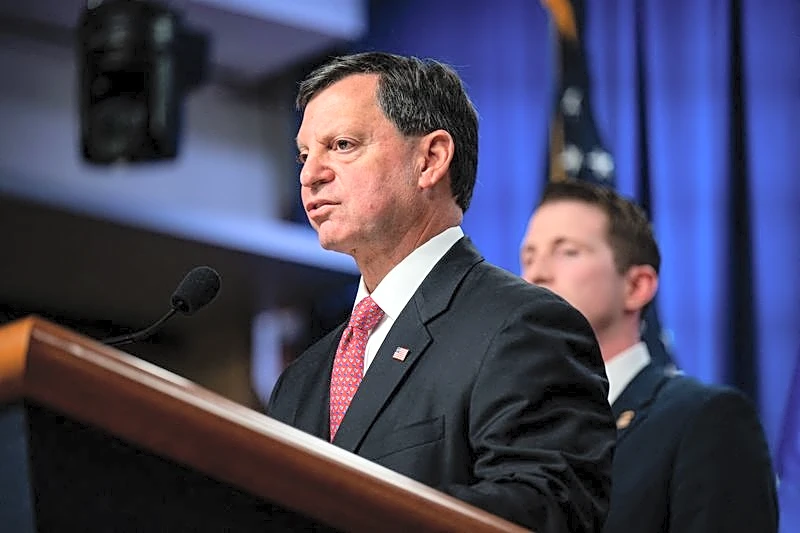
The inability of federal agencies to accurately track office vacancies represents a substantial financial burden on taxpayers. With millions of dollars tied up in underutilized or vacant office spaces, the government is missing opportunities for significant cost savings. Demian Brady, vice president of research at the National Taxpayers Union Foundation, emphasizes that investments in better tracking mechanisms should be viewed as a means to lower future taxpayer bills on federal office properties. The current situation highlights inefficiencies in federal property management and raises questions about accountability and resource allocation. Effective management of federal real estate could free up substantial funds that could be redirected to other critical government programs or contribute to reducing the national debt, directly impacting economic stakeholders and public policy.
What's Next?
Following the GAO report, federal agencies are expected to continue their efforts to reduce office space, with some already planning cuts to leases and properties. However, the effectiveness of these initiatives will largely depend on improving data collection and reporting mechanisms. Agencies like the Department of the Interior and the Department of Homeland Security will need to address their technological and procedural shortcomings in tracking employee presence and office utilization. The broader implication is a potential push for more robust federal property reform, possibly revisiting past unsuccessful attempts to establish public buildings reform boards. The focus will likely be on implementing more precise metrics for occupancy and ensuring that agencies are held accountable for optimizing their real estate portfolios to maximize taxpayer value.
Beyond the Headlines
The issue of federal office vacancies extends beyond mere financial inefficiency; it touches upon the evolving nature of work, particularly in the post-pandemic era, and the ethical responsibility of government stewardship. The shift towards remote and hybrid work models has fundamentally altered how office spaces are utilized, making accurate occupancy data even more critical. The GAO report implicitly suggests a disconnect between traditional office space allocation and contemporary work patterns. This situation also raises questions about transparency and accountability within federal bureaucracy. The challenge is not just about cutting costs but about modernizing federal operations to reflect current realities and ensure that taxpayer money is used as efficiently and effectively as possible. The long-term implications could include a significant reduction in the federal real estate footprint, potentially leading to urban planning changes in areas with large government offices and a re-evaluation of federal employment policies.