







What's Happening?
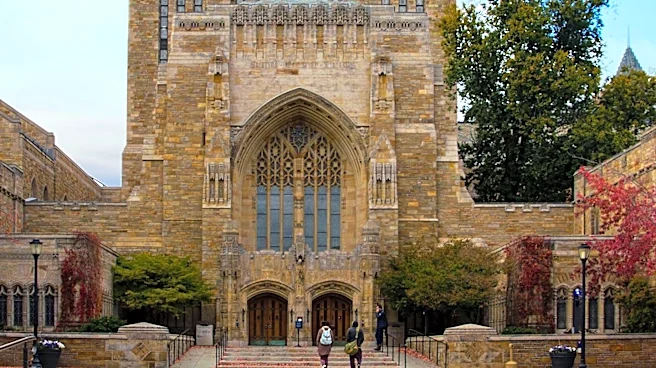
Yale University has announced the appointment of Lesley Rosenthal as its new university secretary, effective December 1. Rosenthal comes to Yale from The Juilliard School, where she served as chief operating officer and corporate secretary since 2018.
Her extensive background includes over two decades of experience in helping non-profit organizations advance their missions through effective governance and strategic planning. Prior to her role at Juilliard, Rosenthal was the general counsel and secretary at Lincoln Center for the Performing Arts from 2005 to 2018, where she played a key role in managing governance and decision-making during a significant $1.2 billion redevelopment project. She has also held leadership positions in the New York State Bar Association and its foundation, and served as vice president of the Board of Overseers at Harvard University. Rosenthal is also recognized for her work in the nonprofit sector, including co-leading the rescue and resettlement of students, faculty, and staff from the Afghanistan National Institute of Music in 2021.
Why It's Important?
Lesley Rosenthal's appointment as University Secretary is significant for Yale as it navigates a pivotal period in its history and the broader landscape of higher education. Her expertise in corporate governance, strategic planning, and institutional stewardship will be crucial in strengthening the university's administrative framework and ensuring its long-term flourishing. The role of university secretary is vital for maintaining institutional integrity, facilitating effective decision-making, and upholding the university's mission. Rosenthal's proven track record in complex organizational environments, such as Lincoln Center's redevelopment and the humanitarian effort for the Afghanistan National Institute of Music, demonstrates her capacity to handle multifaceted challenges. Her deep belief in and passion for education, particularly expanding opportunities for young people, aligns with the core values of a leading academic institution like Yale, promising a dedicated and purpose-driven approach to her new responsibilities.
What's Next?
Lesley Rosenthal will officially assume her duties as Yale University Secretary on December 1. Her immediate focus will likely involve integrating into Yale's administrative structure, familiarizing herself with the university's current priorities, and collaborating with President Maurie McInnis and other university leaders. She will be tasked with stewarding corporate governance, contributing to strategic initiatives, and overseeing administrative and operational aspects to support Yale's mission. The transition also involves Kimberly Goff-Crews, the outgoing university secretary, who will expand her responsibilities as vice president for university life. This shift indicates a strategic prioritization of the university life portfolio, with Goff-Crews continuing her vital role within the community. Rosenthal's arrival is expected to bring fresh perspectives and reinforce Yale's commitment to strengthening its scholarly community and advancing knowledge.
Beyond the Headlines
Rosenthal's background, particularly her work in nonprofit governance and her involvement in the rescue of the Afghanistan National Institute of Music, highlights a broader trend of academic institutions seeking leaders with diverse and impactful experiences beyond traditional academic administration. Her expertise in navigating complex organizational structures and her commitment to education and humanitarian efforts suggest a potential for Yale to further integrate social impact and ethical considerations into its governance and strategic planning. Her book, 'Good Counsel: Meeting the Legal Needs of Nonprofits,' underscores her thought leadership in institutional stewardship, which could influence Yale's approach to its own legal and ethical frameworks. This appointment reflects a recognition that modern universities require leaders who can not only manage internal operations but also engage with broader societal challenges and uphold institutional values in a rapidly changing world.