




What's Happening?
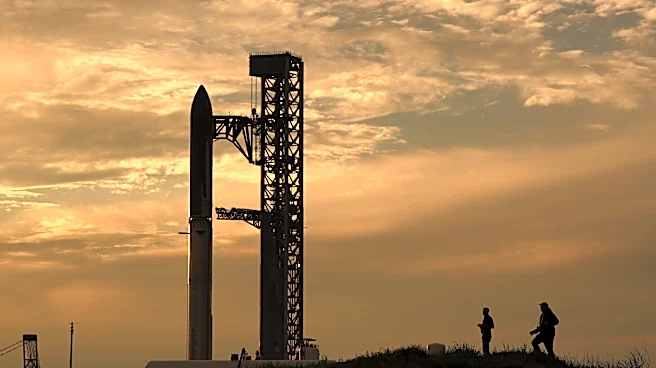
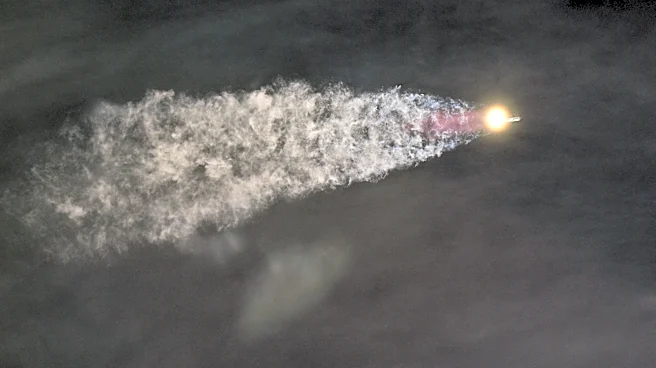
SpaceX's latest Starship launch from Texas on Friday experienced a significant setback during the recovery phase of its Super Heavy rocket booster. While the Starship spacecraft successfully soared into orbit, the first-stage booster, intended for reuse,
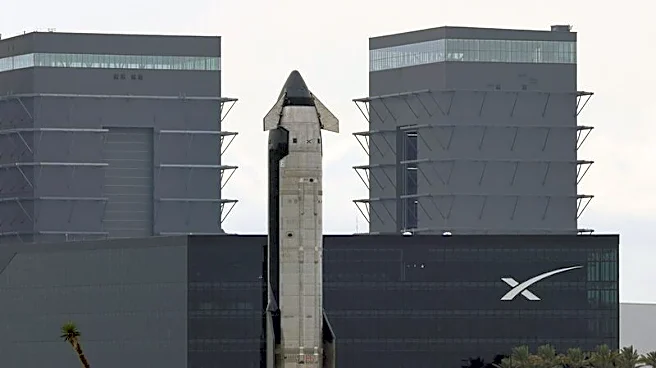
failed its planned return to the launch site. Instead of executing a controlled landing, the booster was diverted offshore and subsequently exploded after a failed attempt at a 'double catch' recovery. This incident marks a deviation from SpaceX's goal of fully reusable rocket systems, as the booster was lost in the Gulf of Mexico. Despite this, the bullet-shaped Starship spacecraft continued its trajectory toward orbit, with plans to attempt a similar recovery maneuver for the spacecraft itself on Saturday. This was the 15th flight of the Starship system, representing a critical test in its development.
Why It's Important?
The failure of the Super Heavy booster's recovery attempt has notable implications for SpaceX's ambitious reusability goals and the broader space industry. Full reusability of both stages of the Starship system is central to SpaceX's strategy for significantly reducing the cost of space access and enabling frequent, large-scale missions to the Moon and Mars. Each failed recovery attempt represents a financial loss and a delay in perfecting the complex landing procedures. While the Starship itself continued its mission, the loss of the booster underscores the technical challenges involved in achieving rapid and reliable reusability. This event could influence investor confidence in the short term and may necessitate further design modifications or operational adjustments for future Starship flights, potentially impacting the timeline for its full operational deployment.
What's Next?
Following the booster's failed recovery, attention now shifts to the Starship spacecraft itself, which is scheduled to attempt a similar landing maneuver back at the launch pad on Saturday. The success or failure of this second recovery attempt will provide further critical data for SpaceX engineers. The company will likely conduct a thorough investigation into the booster's failure to identify the root cause and implement corrective measures. Future Starship test flights will undoubtedly incorporate lessons learned from this incident, focusing on refining the booster's descent and landing systems. Depending on the findings, SpaceX may adjust its testing schedule or modify hardware and software to enhance the reliability of its recovery operations, which are crucial for its long-term objectives in space exploration and satellite deployment.
Beyond the Headlines
This incident highlights the inherent risks and complexities involved in advanced rocket technology development, even for a company as experienced as SpaceX. While the public often focuses on successful launches, the intricate dance of recovery and reuse is equally, if not more, challenging. The pursuit of full reusability pushes the boundaries of engineering, requiring precise control, robust materials, and sophisticated autonomous systems. Failures like this, while setbacks, are often integral to the iterative development process in aerospace, providing invaluable data that leads to eventual success. The long-term implications extend to the future of space travel, as the economic viability of ambitious missions to other planets hinges on achieving routine and cost-effective access to space, a goal that reusability is designed to unlock.