




What's Happening?
Dr. Reto A. Ruedy, associated with Autonomic Integra LLC and the NASA Goddard Institute for Space Studies (GISS), is actively involved in significant climate research. His recent publications highlight contributions to several key areas. In 2026, he co-authored
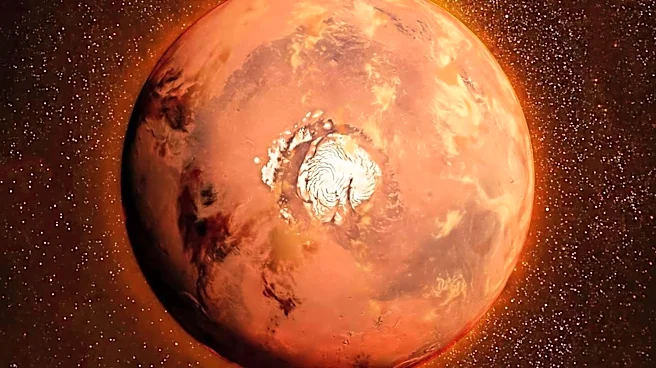
a study on the NASA-GISS ModelE2.1-CC2 Earth System Model, focusing on its development and simulations. Another 2026 publication details a modeling framework for asynchronous land-atmosphere coupling using NASA GISS ModelE and LPJ-LMfire, designed for evaluating a 2.5 ka period. A 2025 paper, co-authored by J.E. Hansen and J. Kelly, questions whether the United Nations and the public are well-informed about the acceleration of global warming. Additionally, Dr. Ruedy contributed to the 2025 update of the ROCKE-3D general circulation model, which is used for simulating the climates of rocky planets. His work also includes a 2024 publication on a GISTEMPv4 observational uncertainty ensemble.
Why It's Important?
Dr. Ruedy's research is crucial for advancing the understanding of climate change and its impacts, both on Earth and potentially on other celestial bodies. The development and refinement of models like NASA-GISS ModelE2.1-CC2 and ROCKE-3D are vital tools for predicting future climate scenarios and assessing the effectiveness of various environmental policies. The paper questioning the public's and the United Nations' awareness of accelerated global warming underscores a critical communication challenge in addressing climate change. Accurate and accessible information is essential for informed decision-making by policymakers and the public, influencing resource allocation, regulatory frameworks, and international cooperation on environmental issues. His work on observational uncertainty ensembles also improves the reliability of climate data, which is fundamental for robust scientific conclusions and policy recommendations.
What's Next?
The ongoing research by Dr. Ruedy and his colleagues at NASA GISS suggests a continued focus on refining climate models and improving the accuracy of climate data. Future work will likely involve further development and application of these advanced models to explore more complex climate interactions and long-term projections. The emphasis on informing the public and international bodies about climate acceleration indicates a potential for increased efforts in scientific communication and outreach. This could lead to new initiatives aimed at bridging the gap between scientific findings and public understanding, potentially influencing future policy debates and public engagement strategies related to climate action. Continued collaboration with international partners and organizations like the United Nations will be essential for translating scientific insights into global climate strategies.
Beyond the Headlines
The work by Dr. Ruedy and NASA GISS extends beyond immediate climate predictions, touching upon the ethical and societal implications of scientific knowledge. The question of whether the public and international bodies are adequately informed about accelerating global warming highlights a broader challenge in the scientific community: effectively communicating complex data to diverse audiences. This involves not only presenting facts but also addressing potential misinformation and fostering a deeper understanding of scientific consensus. The development of planetary climate models, while seemingly distant, also contributes to a larger scientific endeavor to understand the conditions for life beyond Earth, potentially influencing future space exploration and astrobiology research. The continuous refinement of these models also raises questions about the role of artificial intelligence and advanced computing in scientific discovery and environmental stewardship.