





What's Happening?
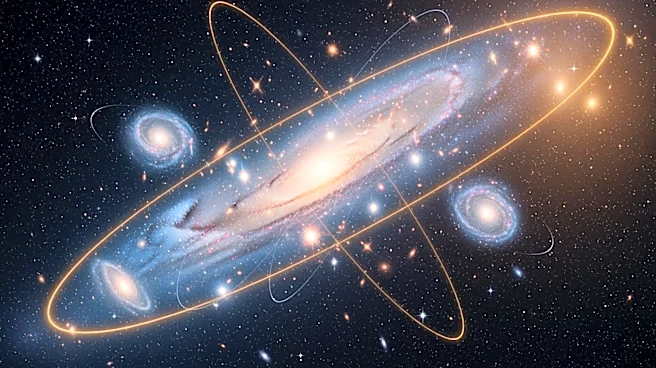
A study by University of Ottawa physicist Rajendra Gupta proposes a new cosmology model suggesting the universe is 26.7 billion years old, significantly older than the widely accepted age of 13.7 billion years. This model combines an expanding universe with
the 'tired light' theory and changing fundamental constants over time. The findings challenge the standard Lambda-CDM model, which has been the dominant framework for understanding cosmic expansion and structure.
Why It's Important?
If validated, this model could revolutionize our understanding of the universe's history and structure. It addresses discrepancies observed by the James Webb Space Telescope, which has detected galaxies that appear more developed than expected for their age. By extending the timeline, this model provides a framework for explaining the rapid formation of massive galaxies and black holes, potentially resolving tensions in current cosmological theories.
What's Next?
Further testing of Gupta's model is necessary to determine its viability. It must be reconciled with key observations such as the cosmic microwave background and big-bang nucleosynthesis. If successful, this model could lead to a paradigm shift in cosmology, prompting a reevaluation of how we interpret redshift and the early universe. The scientific community will likely engage in rigorous debate and experimentation to explore the implications of this new framework.
Beyond the Headlines
The proposal raises philosophical questions about the nature of scientific progress and the willingness to challenge established theories. It highlights the dynamic nature of scientific inquiry, where new data can prompt significant shifts in understanding. This development underscores the importance of open-mindedness and adaptability in scientific research, as well as the potential for technological advancements like the James Webb Space Telescope to drive innovation in theoretical models.