






What's Happening?
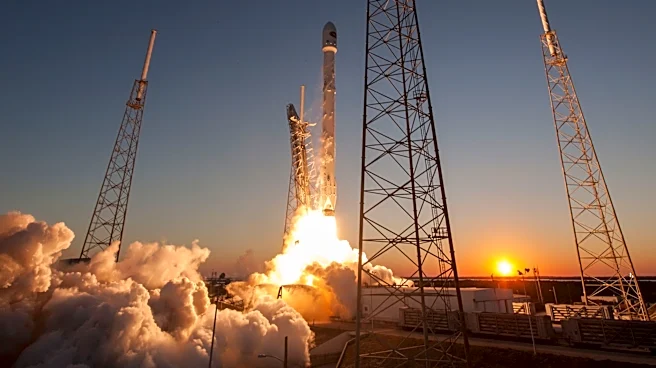
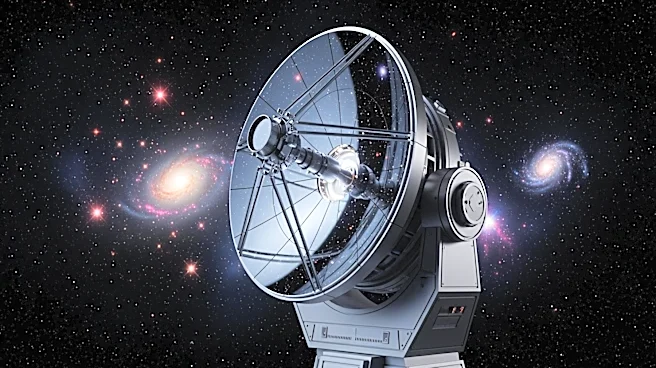
NASA's Nancy Grace Roman Space Telescope has arrived at the Kennedy Space Center in Florida for final preparations before its scheduled launch aboard a SpaceX Falcon Heavy rocket. The telescope, transported from NASA's Goddard Space Flight Center, will
undergo a series of tests and preparations at the Payload Hazardous Servicing Facility. The Roman Telescope is set to be launched to the Sun-Earth Lagrange point two (L2), where it will conduct a mission lasting at least five years. Its primary objectives include studying dark energy, the universe's expansion, and discovering new exoplanets and black holes.
Why It's Important?
The Roman Space Telescope represents a significant advancement in space observation technology, joining the ranks of other major observatories like Hubble and Webb. Its mission to explore dark energy and the universe's expansion could provide critical insights into fundamental cosmic questions. The telescope's findings may influence our understanding of the universe's structure and evolution, impacting fields such as astrophysics and cosmology. The mission also underscores the importance of international collaboration and technological innovation in advancing space exploration.
What's Next?
As the launch date approaches, NASA will continue to conduct rigorous tests to ensure the telescope's readiness. Once launched, the Roman Telescope will begin its journey to L2, where it will start its scientific mission. The data collected will be analyzed by scientists worldwide, potentially leading to groundbreaking discoveries. The success of this mission could pave the way for future space telescopes and missions, further expanding our knowledge of the universe.