



What's Happening?
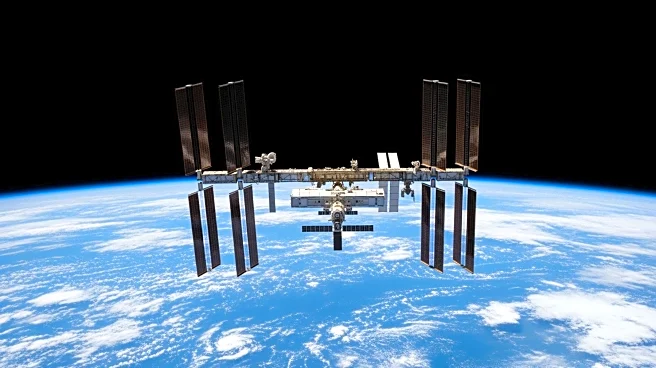
NASA recently marked the 25th anniversary of continuous human habitation on the International Space Station (ISS), a milestone that underscores the station's role as a hub for international collaboration and scientific research. Since its inception, the ISS has
hosted 290 visitors from 26 countries, fostering a unique community where astronauts share cultural traditions, cuisine, and music. The station serves as a training ground for future deep space missions, including NASA's Artemis missions to the Moon and Mars. The ISS has also become a living archive of human experience, with astronauts capturing millions of photographs of Earth, which are used for scientific research and disaster response. The station's crew members have engaged in various cultural activities, such as playing musical instruments and celebrating holidays, which help maintain morale and camaraderie in space.
Why It's Important?
The 25-year milestone of the ISS highlights the importance of international cooperation in space exploration. The station's continuous operation has provided invaluable data and experience that are crucial for future missions beyond low Earth orbit. The ISS has been instrumental in advancing scientific research, with experiments conducted in microgravity leading to breakthroughs in various fields, including medicine and materials science. The cultural exchanges and community-building activities aboard the ISS demonstrate the potential for space exploration to unite people across the globe. The station's success also reinforces the need for sustained investment in space infrastructure, which can drive technological innovation and economic growth.
What's Next?
Looking ahead, the ISS will continue to play a pivotal role in preparing for NASA's Artemis missions, which aim to return humans to the Moon and eventually send astronauts to Mars. The station will serve as a testbed for new technologies and systems required for long-duration space travel. As NASA and its international partners plan for the future of human spaceflight, discussions about the eventual transition from the ISS to commercial space stations are underway. This transition will involve collaboration with private companies to ensure a sustainable presence in low Earth orbit, paving the way for expanded commercial activities in space.
Beyond the Headlines
The ISS's legacy extends beyond scientific and technological achievements. It represents a symbol of peace and cooperation, demonstrating how nations can work together to achieve common goals. The cultural and artistic endeavors aboard the station, such as the Space for Art Foundation's initiatives, highlight the human spirit's resilience and creativity. These projects connect people on Earth with the wonders of space, inspiring future generations to pursue careers in science, technology, engineering, and mathematics (STEM). As the ISS continues to orbit, it serves as a reminder of humanity's shared responsibility to protect our planet and explore the universe.