

What's Happening?
The Pan-American Highway, conceived in 1923 as a continuous road linking the Western Hemisphere from Alaska to Tierra del Fuego, remains incomplete, notably at the Darién Gap between Panama and Colombia. Brazilian army officer Leônidas Borges de Oliveira
undertook a pioneering, decade-long journey from Rio de Janeiro to Washington D.C. starting in 1928, demonstrating the feasibility of intercontinental travel despite immense challenges. His expedition, which involved disassembling vehicles to traverse impassable terrain, was met with skepticism by U.S. officials upon his arrival in 1938. While the U.S. declared its interstate system part of the Pan-American Highway network in 1966, and significant road construction occurred across the Americas, the Darién Gap has remained an unbridged divide since 1980. This unfinished status is attributed more to political decisions than topographical difficulties, with Panama viewing the Gap as a natural border wall against Colombian immigration. The initial ideals of unrestricted mobility and hemispheric fraternity that inspired the highway's creation have largely been subverted by increasingly restrictive immigration policies, particularly north of the Darién Gap.
Why It's Important?
The incomplete Pan-American Highway serves as a powerful symbol of the divergence between aspirational ideals of hemispheric unity and the realities of national borders and immigration policies. The initial vision of a 'Highway of Friendship' promoting unfettered travel and cultural exchange has been overshadowed by nativist sentiments and restrictive immigration laws, particularly in North and Central America. The Darién Gap, once seen as a geographical obstacle to be overcome, has evolved into a deliberate political barrier, reflecting Panama's concerns about migration. This situation highlights how infrastructure projects, even those conceived with grand unifying visions, can become entangled in complex geopolitical and social issues. The contrast with South America, where nations have moved towards greater freedom of movement for their citizens, underscores a significant ideological split within the hemisphere regarding immigration and regional integration. This historical trajectory reveals how national interests and fears can override broader cooperative goals, impacting both physical connectivity and human mobility.
What's Next?
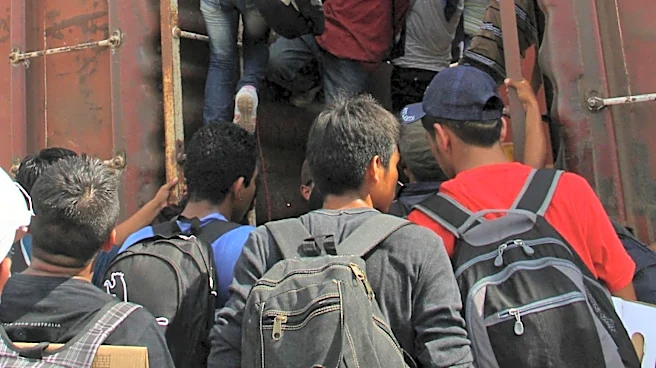
The Darién Gap is likely to remain an uncompleted section of the Pan-American Highway for the foreseeable future, as political will in Panama continues to prioritize it as a barrier to migration. The ongoing flow of migrants through the Gap, despite its dangers, will continue to pose humanitarian challenges and fuel debates about border security and international cooperation. The contrasting approaches to immigration in North and South America suggest a continued divergence in regional policies, with South American nations potentially expanding their free movement zones while North America maintains or strengthens its border controls. Discussions about the highway's completion will likely remain theoretical, overshadowed by the practical realities of migration and national sovereignty. The legacy of the Pan-American Highway will continue to be a testament to both the ambition of intercontinental connectivity and the enduring power of national borders and immigration politics.
Beyond the Headlines
The story of the Pan-American Highway's incompleteness delves into the profound ethical and cultural dimensions of borders and human mobility. The initial vision of a road without barriers, championed by figures like Oliveira, reflected a progressive ideal of universal freedom of movement, echoing Brazil's post-slavery constitutional guarantees. However, the subsequent hardening of borders, particularly in the U.S. and Central America, transformed the highway from a symbol of unity into a conduit for controlled migration, and for the poor and 'car-less,' often a path to legal obstacles. The deliberate embrace of the Darién Gap as a 'border wall' by Panamanian officials, and the U.S.'s shift towards restrictive immigration policies in the 1920s, illustrate how national identity and economic anxieties can lead to the redefinition of who is 'welcome.' This narrative highlights the inherent tension between the globalizing forces of infrastructure and trade, and the localizing forces of national sovereignty and cultural protectionism. It also exposes the often-unseen human cost of these policies, as migrants navigate treacherous routes and face discrimination, underscoring that true 'freedom of movement' remains an elusive ideal for many.