
What's Happening?
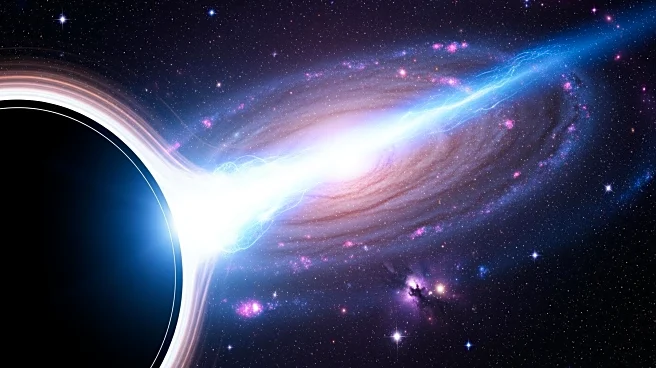
A team of computational astrophysicists has developed the most detailed model yet of black hole accretion, a process where black holes draw in surrounding matter and emit radiation. This new model, which
fully incorporates Einstein's theory of gravity and the role of radiation, marks a significant advancement in black hole research. The study, published in The Astrophysical Journal, was led by scientists from the Institute for Advanced Study and the Flatiron Institute's Center for Computational Astrophysics. The research utilized powerful supercomputers to simulate how matter flows into black holes, providing insights into their behavior in extreme environments. This model is the first to accurately simulate these processes without relying on simplifying assumptions, offering a new perspective on black hole systems.
Why It's Important?
This breakthrough in black hole simulation is crucial for advancing our understanding of these enigmatic cosmic entities. By accurately modeling the interaction of gravity and radiation, scientists can better interpret astronomical observations and predict black hole behavior. This research not only enhances theoretical astrophysics but also aids in the interpretation of data from telescopes observing black holes. The ability to simulate black hole environments with high fidelity could lead to new discoveries about the formation and evolution of galaxies, as black holes play a pivotal role in these processes. The study's success demonstrates the potential of computational astrophysics to solve complex problems and push the boundaries of space science.
What's Next?
The research team plans to extend their model to study different types of black holes, including supermassive ones, which are central to galaxy formation. Future work will focus on refining the model to account for various temperatures and densities, potentially revealing new insights into black hole dynamics. The ongoing development of this computational framework will likely lead to further breakthroughs in understanding the universe's most extreme environments. As the model is applied to more black hole systems, it could also inform the design of future observational missions and experiments.