



What's Happening?
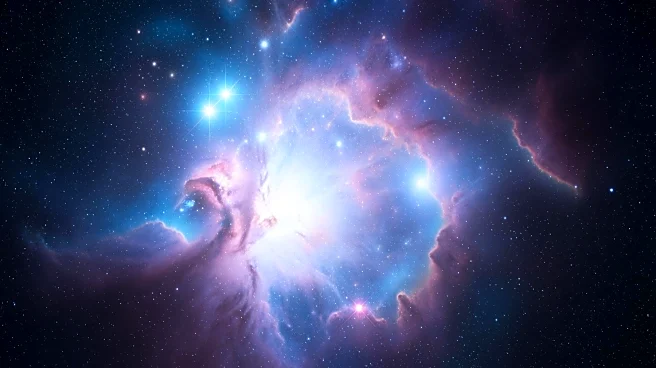
NASA's Hubble Space Telescope has captured a new image of the star-forming region NGC 1333, showcasing a variety of young stellar objects. The image features a protostar with a protoplanetary disk, reflection nebulae, and Orion variable stars. These objects are
part of a cosmic panorama located about 950 light-years away in the Perseus molecular cloud. The image provides insights into the properties of circumstellar disks and outflows, contributing to our understanding of star formation processes. The Hubble observations aim to study the evolution of young stars and their surrounding environments.
Why It's Important?
The Hubble image offers valuable data on the early stages of star formation, which is crucial for understanding the lifecycle of stars and the formation of planetary systems. By studying young stellar objects and their environments, astronomers can gain insights into the processes that lead to the formation of stars and planets. This research enhances our knowledge of the universe's evolution and the conditions necessary for the development of life. The findings also contribute to the broader field of astrophysics, providing a foundation for future studies of star formation.