
What's Happening?
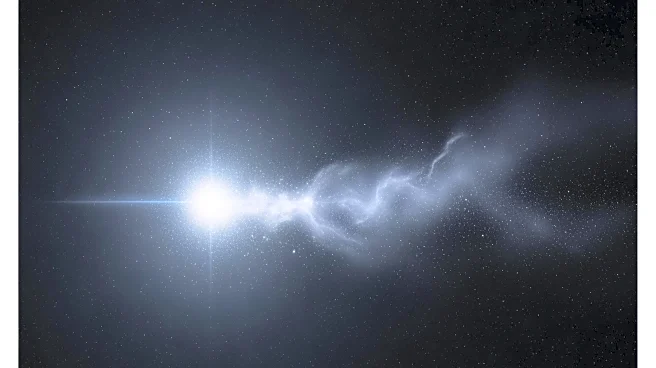
The Hubble Space Telescope has captured a striking image of a protostar and a reflection nebula in the star-forming region of NGC 1333, located within the Perseus molecular cloud approximately 950 light-years from Earth. The image reveals a protostar surrounded
by a protoplanetary disk, with starlight illuminating the surrounding dust grains, creating a reflection nebula. This phenomenon occurs as the protostar accretes material from its disk while simultaneously ejecting powerful outflows, shaping the environment for future star and planet formation.
Why It's Important?
The observation of regions like NGC 1333 is crucial for astronomers to understand the intricate processes of star formation. By studying these areas in both infrared and visible light, scientists can gain insights into the episodic nature of star growth and the dynamic interactions between accretion and ejection processes. This knowledge is fundamental to understanding the origins of stars and planetary systems, including our own solar system, as it provides a glimpse into the early stages of stellar evolution and the conditions that lead to the formation of planets.