



What's Happening?
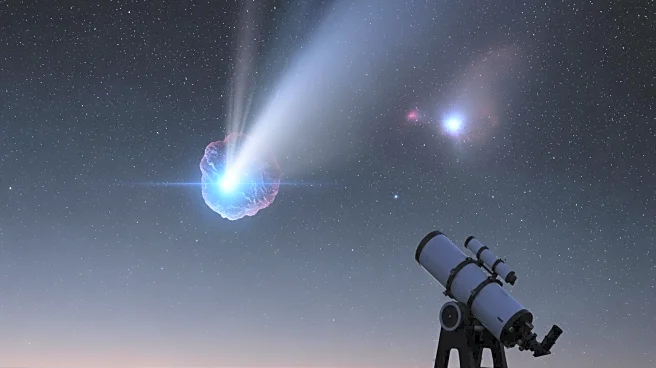
Interstellar comet 3I/ATLAS is making its closest approach to Earth on December 19, 2025. Discovered on July 1, 2025, by astronomers using the Asteroid Terrestrial-impact Last Alert System (ATLAS) survey telescopes, this comet is only the third known
interstellar object to visit our solar system. At its closest, 3I/ATLAS will be 170 million miles from Earth, making it invisible to the naked eye. However, it can be tracked using a 12-inch telescope or through various online resources. NASA's Eyes on the Solar System provides a 3D model to visualize the comet's path, while the Comet Observation Database allows users to track its brightness. Additionally, the Virtual Telescope Project will livestream the event, offering real-time images of the comet.
Why It's Important?
The approach of 3I/ATLAS presents a rare opportunity for astronomers and the public to observe an interstellar object. Such events are significant for scientific research, as they provide insights into the composition and behavior of objects from outside our solar system. Understanding these interstellar visitors can enhance knowledge about the formation and evolution of other star systems. For the public, the event offers a chance to engage with astronomy and space science, potentially inspiring interest in these fields. The use of technology to track and visualize the comet also highlights advancements in astronomical observation tools.
What's Next?
Following its closest approach to Earth, 3I/ATLAS will continue its journey through the solar system, passing beyond Mars and approaching Jupiter by March 12, 2026. Astronomers will continue to study its trajectory and characteristics, contributing to the broader understanding of interstellar objects. The data collected during this period will be analyzed to refine models of comet behavior and interstellar dynamics. Public interest may lead to increased participation in amateur astronomy and further engagement with space exploration initiatives.