
What's Happening?
Australia has launched a Counter Terrorism Online Centre in Sydney, a joint initiative between ASIO and the Australian Federal Police, to monitor online radicalization and terrorism threats. This new intelligence
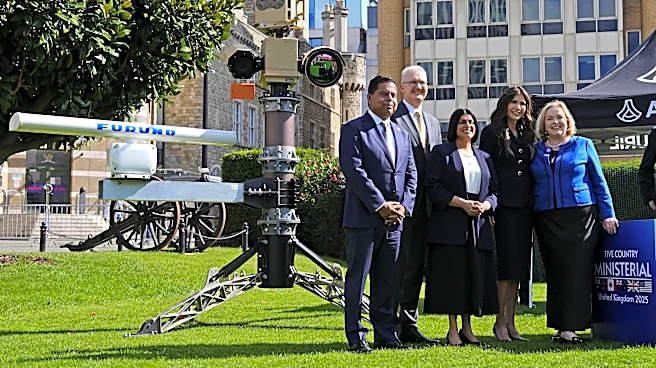
hub will serve as a single entry point for overseas agencies to share information on potential national security threats originating online. Home Affairs Minister Tony Burke is set to be briefed on an overhaul of Australia's threat level rating system, with the hope that all Five Eyes countries—Australia, Canada, the United Kingdom, the United States, and New Zealand—will adopt similar methods for recording threat levels. Australian Federal Police Commissioner Krissy Barrett noted that the nation is facing 'terrorism 2.0,' emphasizing that traditional counter-terrorism lessons may not apply to the rapid shift in the online threat environment. The federal government allocated $74 million in May's budget to establish this center.
Why It's Important?
The establishment of Australia's Counter Terrorism Online Centre and the push for harmonized threat level reporting among Five Eyes nations signify a critical adaptation to the evolving nature of terrorism. For the United States, this initiative is important as it enhances intelligence sharing and coordination against online radicalization, a significant national security concern. A unified approach to threat assessment across the Five Eyes alliance would improve the collective ability to identify, track, and respond to extremist activities that often originate or spread online. This collaboration can lead to more effective strategies for disrupting terrorist networks, preventing attacks, and safeguarding citizens. The recognition of 'terrorism 2.0' highlights the need for innovative solutions to combat threats that leverage encrypted communications and rapid online radicalization, directly impacting U.S. security interests.
What's Next?
The Counter Terrorism Online Centre will continue to integrate intelligence from various sources, including overseas agencies, to enhance its monitoring and response capabilities. The proposed overhaul of Australia's threat level system, with an aim for Five Eyes alignment, suggests future discussions and potential policy changes among the allied nations to standardize how online threats are assessed and communicated. Operatives at the center will receive specialized training to identify individuals at risk of radicalization. This initiative is likely to foster closer operational ties and intelligence exchanges between Australian agencies and their Five Eyes counterparts, particularly in the realm of online counter-terrorism. The focus will be on developing advanced methods to penetrate encrypted communications and engage with individuals involved in extremist activities online.
Beyond the Headlines
This development underscores the profound impact of digital platforms on national security, transforming the battle against terrorism into a complex online endeavor. The shift to 'terrorism 2.0' implies that traditional intelligence gathering methods are insufficient, necessitating a proactive online presence from security agencies. This raises ethical and legal questions about surveillance in encrypted spaces and the balance between national security and individual privacy rights. The effort to standardize threat levels across Five Eyes countries also points to a broader trend of international cooperation in cybersecurity and intelligence, potentially leading to more integrated global security frameworks. However, it also highlights the challenge of maintaining democratic oversight and accountability in highly secretive, cross-border intelligence operations, especially when dealing with rapidly evolving online threats.