
What's Happening?
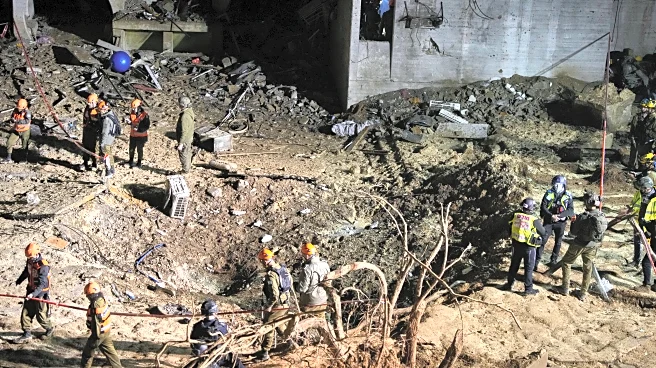
The United Arab Emirates (UAE) has activated its air defenses in response to a series of missile and drone attacks launched by Iran. According to the UAE's Defense Ministry, Iran has fired 15 cruise missiles, 345 ballistic missiles, and 1,773 drones towards
the Gulf state, including four ballistic missiles and 25 drones on a recent Sunday. The UAE's Deputy Prime Minister and Foreign Minister, Abdullah bin Zayed Al Nahyan, publicly stated that the Emirates will not succumb to 'terrorist blackmail,' a comment made in response to criticism from Gerard Araud, a former French ambassador. Araud had criticized the UAE's policy of denouncing Iran and strengthening ties with Washington, suggesting it deepens the UAE's dependence on the U.S. The UAE's stance is supported by its presidential advisor, Anwar Gargash, who emphasized that Iranian aggression solidifies the Iranian threat as a key concern for Gulf strategic planning.
Why It's Important?
The escalation of hostilities between Iran and the UAE, along with other Gulf states like Kuwait and Saudi Arabia, underscores the fragile security situation in the region. The UAE's decision to activate its air defenses highlights the seriousness of the threat posed by Iran's military actions. This development could lead to increased military cooperation between the UAE and the United States, as the Gulf states seek to bolster their security frameworks. The situation also reflects broader geopolitical tensions, as Gulf countries navigate their relationships with major powers like the U.S. and Iran. The ongoing conflict could impact global oil markets, given the strategic importance of the Gulf region in energy production and distribution.
What's Next?
The UAE and its Gulf allies are likely to continue strengthening their defense capabilities and security partnerships, particularly with the United States. This could involve increased military aid, joint exercises, and intelligence sharing. The international community, including the United Nations, may call for diplomatic efforts to de-escalate tensions and prevent further military confrontations. Additionally, the situation may prompt discussions within the Gulf Cooperation Council (GCC) to develop a unified response to Iranian aggression. The potential for retaliatory actions by Iran or further escalation remains a significant concern for regional stability.