








What's Happening?
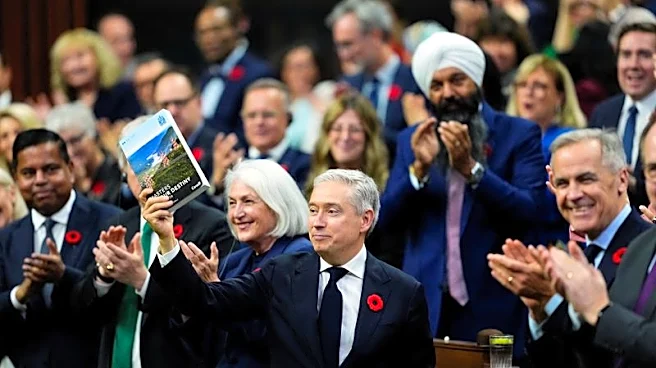
The documentary film 'Man In Motion: The Rick Hansen Story,' which premiered at the Toronto International Film Festival (TIFF) in September, was recently screened on Parliament Hill. This event highlighted the ongoing efforts to address accessibility
gaps, more than 40 years after Canadian athlete and activist Rick Hansen embarked on his historic world tour. In 1985, Hansen wheeled over 40,000 kilometers across 34 countries to advocate for inclusion and break down barriers for people with disabilities. Despite significant progress, Hansen emphasized that much work remains to be done, particularly in the 'built environment.' He noted that current minimum compliance codes for accessibility are insufficient, leading to the creation of new barriers. The federal government's 2022 Canadian Survey on Disability reported that 8 million Canadians, or over 27% of the population, live with a disability, underscoring the widespread impact of these issues.
Why It's Important?
The screening of 'Man In Motion: The Rick Hansen Story' on Parliament Hill underscores the persistent challenges in achieving full accessibility and inclusion for people with disabilities in Canada. Hansen's message highlights that while awareness has grown, tangible progress in areas like the built environment is lagging. This is crucial because inadequate accessibility not only restricts the mobility and participation of individuals with disabilities but also represents a significant societal and economic cost. By failing to implement comprehensive accessibility standards, Canada risks perpetuating systemic inequalities and limiting the potential contributions of a substantial portion of its population. The call for accelerated progress and wise spending on accessibility programs suggests a need for more robust policy implementation and enforcement, moving beyond minimum compliance to truly inclusive design. This issue resonates beyond Canada, as many nations grapple with similar challenges in creating truly accessible societies.
What's Next?
Rick Hansen's advocacy calls for an acceleration of progress in accessibility, particularly in the built environment, moving beyond minimum compliance codes. He stresses the importance of sustained programs and ensuring that government spending on accessibility is effective and leads to meaningful inclusion. The federal government's Accessible Canada Act, adopted in 2019, aims to make Canada barrier-free by 2040. However, Hansen views this as an ongoing process, emphasizing that accessibility and inclusion extend beyond physical structures to encompass how people engage and connect. Future efforts will likely focus on strengthening policy implementation, increasing funding for accessible infrastructure, and fostering a cultural shift towards proactive inclusive design rather than reactive compliance. This ongoing dialogue will involve policymakers, disability advocates, and the construction industry to ensure that future developments are inherently accessible.
Beyond the Headlines
The narrative surrounding Rick Hansen's 'Man In Motion' tour and the subsequent documentary extends beyond mere physical accessibility, touching upon deeper ethical and cultural dimensions. Hansen's journey, initiated over four decades ago, highlighted not just the physical barriers but also the attitudinal and systemic ones that marginalize individuals with disabilities. His continued advocacy for 'accelerated progress' suggests a critique of incremental changes, arguing that society must fundamentally re-evaluate its approach to inclusion. The idea that disability is 'the only club that eventually everyone is going to join' serves as a powerful reminder of universal vulnerability and the shared human experience, urging a more empathetic and proactive stance on accessibility. This perspective challenges societies to view accessibility not as a special provision but as a fundamental aspect of human rights and societal well-being, fostering a culture where no one is left behind.