
What's Happening?
A recently discovered photograph of 19th-century British astronomer Richard Carrington has surfaced, providing a visual identity to the man who first linked solar flares to geomagnetic storms. Carrington is renowned
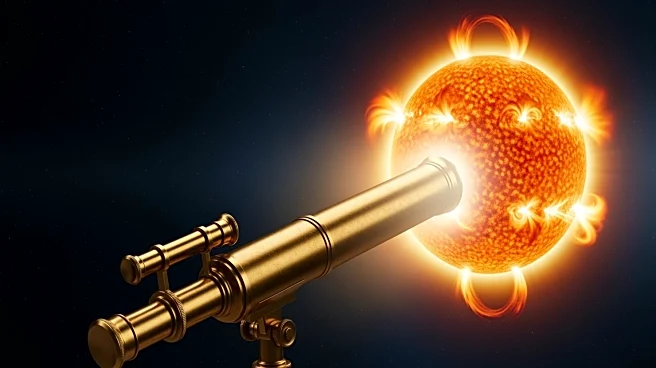
for observing the first recorded solar flare on September 1, 1859, which led to the most intense geomagnetic storm ever documented, known as the Carrington Event. This event caused significant disruptions, such as electric shocks to telegraph operators and auroras visible as far south as Panama. The photograph was found by Kate Bond, an assistant archivist at the Royal Astronomical Society, who identified it through detective work involving auction sites and historical records. The image, believed to be the only known photograph of Carrington, was confirmed through inscriptions and historical context.
Why It's Important?
The discovery of Carrington's photograph is significant as it humanizes a pivotal figure in the field of solar physics, whose work laid the foundation for the science of space weather. Understanding solar storms is crucial for modern technology-dependent societies, as such events can disrupt communication systems, power grids, and satellites. Carrington's observations continue to influence current research on solar activity and its effects on Earth. The photograph not only enriches historical records but also serves as a reminder of the enduring impact of scientific discoveries on contemporary life.
What's Next?
The photograph's addition to the Royal Astronomical Society's archives may inspire further research into Carrington's work and its implications for current space weather studies. As solar activity remains a critical area of study, the renewed interest in Carrington's contributions could lead to advancements in predicting and mitigating the effects of solar storms. Researchers may also explore other historical figures in science whose contributions have been overlooked due to a lack of visual representation.
Beyond the Headlines
The discovery highlights the intersection of history, science, and technology, illustrating how archival research can uncover forgotten aspects of scientific heritage. It also underscores the importance of preserving historical records and photographs, which can provide valuable insights into the development of scientific disciplines. The story of Carrington's photograph serves as a testament to the collaborative nature of scientific discovery and the role of archivists in preserving and interpreting scientific history.