
What's Happening?
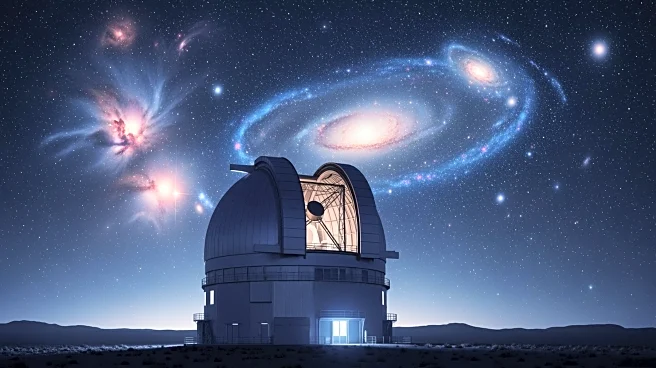
The Vera C. Rubin Observatory, located in the mountains of Chile, is set to transform astronomical research with its state-of-the-art telescope equipped with the world's largest digital camera. This facility
will collect more astronomical data in a single year than all other observatories combined. The observatory aims to enhance our understanding of the universe by capturing detailed images of celestial objects, revealing faint or invisible details such as gas and dust clouds in distant nebulae. The observatory's capabilities promise to usher in a new era of cosmic discovery, providing unprecedented insights into the structure and evolution of the universe.
Why It's Important?
The Vera C. Rubin Observatory represents a significant advancement in astronomical research, offering the potential to answer fundamental questions about the universe. By capturing vast amounts of data, the observatory will enable scientists to study cosmic phenomena with greater precision and detail. This could lead to breakthroughs in understanding dark matter, dark energy, and the formation of galaxies. The observatory's findings may also have implications for other scientific fields, such as physics and cosmology, and could inspire new technologies and innovations.
What's Next?
As the observatory begins its operations, researchers will focus on analyzing the data collected to uncover new insights into the universe. The observatory is expected to contribute to major scientific discoveries and collaborations, fostering international partnerships in the field of astronomy. The data collected will be made available to the global scientific community, promoting open research and innovation.