







What's Happening?
Researchers from the Shibaura Institute of Technology, in collaboration with international experts, have developed and tested adaptive-focus displays for virtual reality (VR) and augmented reality (AR) systems. These displays aim to resolve the vergence-accommodation
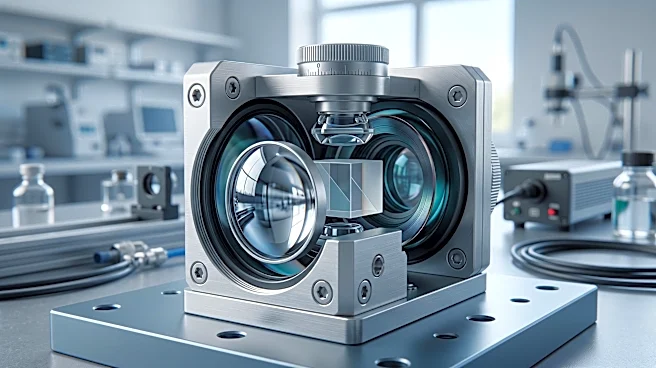
conflict (VAC), a common issue in current VR/AR technologies where the eyes converge on a virtual object at one distance but focus at a fixed, different distance. The team utilized a custom varifocal AR display that integrates real-scene light with virtual images reflected by a spherical mirror and beamsplitter. This system dynamically adjusts the focal plane to match the depth of virtual objects. In a 3D pointing task, participants using the varifocal display showed significant improvements in average movement speed and information throughput, without a notable increase in error rates, particularly for movements involving depth. The study, published in the journal Virtual Reality, involved 24 participants in an initial phase and 12 additional participants for hardware verification.
Why It's Important?
The development of adaptive-focus displays holds significant importance for the advancement of VR and AR technologies, particularly in the U.S. market, which is a major hub for technological innovation and adoption. By mitigating the vergence-accommodation conflict, these displays can lead to more natural and comfortable user experiences, potentially reducing eye strain and discomfort associated with prolonged VR/AR use. This improvement in user experience could accelerate the adoption of VR/AR in various sectors, including professional training, remote work, entertainment, and healthcare. Industries relying on precise 3D interaction, such as engineering, design, and medical imaging, stand to gain from enhanced accuracy and efficiency. While the benefits varied among users, the overall improvement in task performance suggests a pathway toward more effective and user-friendly immersive technologies, which could drive further investment and innovation in the U.S. tech industry.
What's Next?
Future research will focus on understanding the individual differences that influence the benefits of varifocal displays, such as variations in binocular vision or depth perception. Assistant Professor Xiaodan Hu suggests that identifying these user characteristics could lead to the development of personalized AR systems tailored to individual needs. Additionally, the current prototype has limitations, including a restricted field of view and the absence of eye-tracking for automatic focus adjustment. Addressing these technical challenges will be crucial for developing more advanced and practical varifocal AR/VR headsets. The long-term effects on eye health and the prevention of eyestrain also require further investigation. Continued advancements in this area could lead to the widespread integration of adaptive-focus technology into commercial VR/AR products, potentially setting new industry standards for immersive display technology.
Beyond the Headlines
The research into adaptive-focus displays touches upon deeper implications regarding human-computer interaction and the future of digital interfaces. The vergence-accommodation conflict highlights a fundamental challenge in replicating natural human visual perception within artificial environments. Overcoming this conflict not only improves user comfort but also blurs the lines between physical and virtual realities, potentially leading to more intuitive and seamless interactions. This technological progression could foster new ethical considerations regarding the nature of reality and the potential for prolonged immersion in digital spaces. Furthermore, the emphasis on personalized AR systems suggests a future where technology adapts more profoundly to individual physiological and cognitive characteristics, moving beyond one-size-fits-all solutions. This shift could redefine accessibility and inclusivity in digital environments, making immersive technologies more effective for a broader range of users.