







What's Happening?
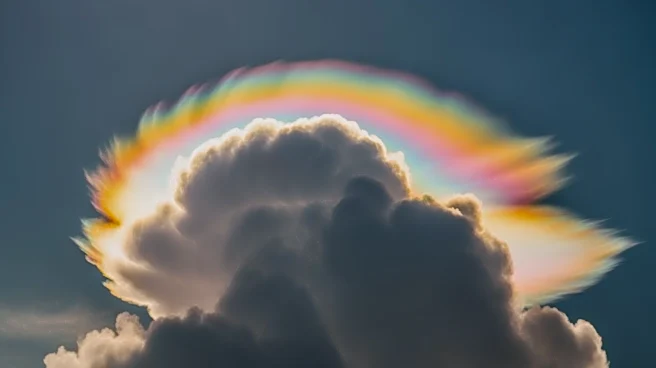
Cloud iridescence, a rare optical phenomenon, has been observed recently in Indonesia, captivating residents with its rainbow-like colors. This phenomenon occurs when sunlight interacts with tiny particles in clouds, such as water droplets or ice crystals,
causing the light to scatter and create vibrant colors. According to Prof. Yuval Reuveni of Ariel University, the phenomenon requires specific conditions, including small, uniform particles in a thin cloud layer. Unlike rainbows, which form through refraction and reflection in larger raindrops, cloud iridescence is caused by diffraction, where light waves scatter at small angles.
Why It's Important?
Cloud iridescence provides insights into atmospheric conditions and the behavior of light. Understanding this phenomenon can enhance knowledge of weather patterns and cloud formation. The occurrence of iridescence highlights the complexity of atmospheric processes and the role of particle size and distribution in optical phenomena. This knowledge can contribute to meteorological studies and improve weather prediction models. The visual spectacle of cloud iridescence also underscores the beauty and intricacy of natural phenomena, inspiring interest in atmospheric science.