


What's Happening?
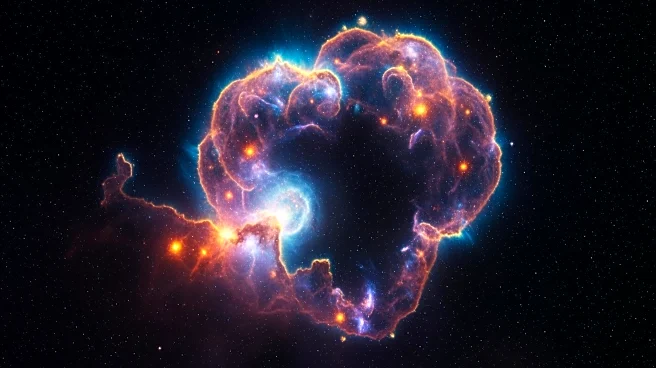
The James Webb Space Telescope (JWST) has captured detailed images of the 'Exposed Cranium' nebula, a planetary nebula located 5,000 light-years away in the constellation Vela. This nebula, resembling a brain encased in a transparent skull, is the remnant
of a dying star. The images, taken by JWST's Near-Infrared Camera (NIRCam) and Mid-Infrared Instrument (MIRI), reveal intricate details of the nebula's structure, including an outer bubble and inner clouds of gas and dust. These observations provide insights into the star's evolutionary stages and the processes occurring within the nebula.
Why It's Important?
The detailed images from JWST enhance our understanding of stellar evolution and the life cycle of stars. By observing the nebula in different wavelengths, astronomers can study the composition and dynamics of the gas and dust, offering clues about the star's past and future. This research contributes to broader astronomical knowledge, helping scientists understand the formation and death of stars, which are fundamental processes in the universe. The findings also demonstrate the capabilities of JWST in revealing previously unseen cosmic phenomena, advancing the field of astronomy.