





What's Happening?
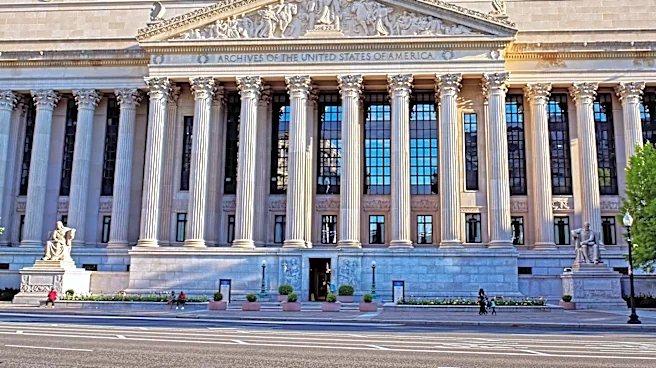
The National Archives and Records Administration (NARA) announced the impending closure of its regional archives and federal records centers in Chicago and San Bruno. This decision, made in June, has sparked significant opposition from local archivists
and Indigenous organizations. Critics argue that scattering approximately 140,000 cubic feet of archival material across the country, with a majority slated for Kansas City and some for Fort Worth, Texas, will impede access to vital federal records. These records include crucial documents from the Bureau of Indian Affairs (BIA) that establish relationships and obligations between Tribal Nations and the United States. Concerns also extend to the potential loss of institutional knowledge held by the 17 employees at the Chicago office, as NARA's justification for the move includes personnel savings, implying no additional staff will be added to new locations. Archivists have formed an anti-closure committee, launched petitions, and engaged with elected officials to block the closures.
Why It's Important?
The planned closures by NARA carry significant implications for historical research, government accountability, and the rights of Tribal Nations. The inaccessibility of federal records, particularly those pertaining to the BIA, could undermine the ability to hold the government accountable for treaty obligations and the management of tribal trust monies. As Veronica Pasfield, a researcher and citizen of the Bay Mills Indian Community, highlighted, these records are essential for proving historical events and ensuring accountability. Larry Wright Jr., executive director of the National Congress of American Indians, emphasized that moving these records away from the communities they serve risks making them harder to access for Tribal Nations whose rights and history they document. Furthermore, the potential loss of experienced archivists and their institutional knowledge could severely impact the proper management and interpretation of these historical documents, which are vital for understanding the nation's past and ensuring the health of its democracy, as noted by historiographer Newland Smith.
What's Next?
Archivists and their allies are actively working to prevent the closures. The Chicago Area Archivists have formed an anti-closure committee, launched petitions, and engaged with elected officials. Illinois Representative Jesús García has co-sponsored the National Archives Protection Act in August, aiming to block the closure, with a corresponding bill introduced in the Senate in September. As the new session of Congress began on November 9th, there are no immediate updates on the progress of these bills. Despite the ongoing legislative efforts, the Chicago facility is still slated for closure. The archivists and their supporters are committed to continuing their fight to preserve historical records, regardless of Capitol Hill's decision. Stakeholders anticipate further advocacy and potential legal challenges as the closure dates approach, with a focus on transparency and maintaining local access to these critical historical documents.
Beyond the Headlines
The controversy surrounding NARA's planned closures highlights deeper issues concerning the stewardship of national heritage and the balance between cost-saving measures and public access to historical records. The argument for personnel savings, while potentially fiscally prudent, overlooks the invaluable institutional knowledge held by long-serving archivists, which is difficult to quantify but crucial for navigating complex historical collections. The ethical dimension of moving records away from the communities they directly impact, particularly Tribal Nations, raises questions about historical justice and equitable access to information. This situation underscores the ongoing tension between centralized management of national archives and the localized needs of researchers and communities. The outcome of this dispute could set a precedent for how federal records are managed and accessed in the future, potentially influencing policies on archival decentralization, digital access, and the role of local expertise in preserving national memory.