



What's Happening?
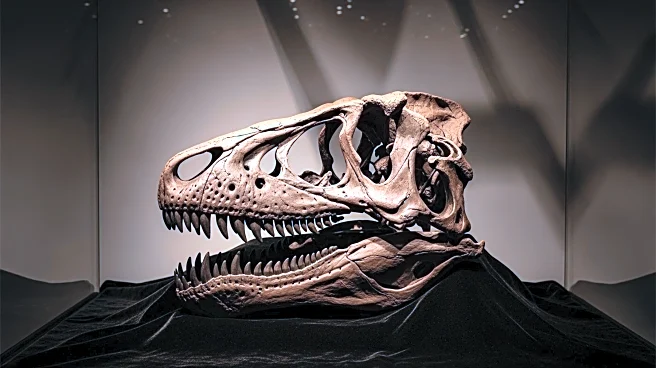
The Smithsonian’s National Museum of Natural History (NMNH) has received a significant addition to its collection with the donation of a nearly complete Pachycephalosaurus skull. This rare fossil, purchased by philanthropists Eric and Wendy Schmidt for
$1.7 million at a Sotheby’s auction, will be displayed at the museum from December 22 to 28. The skull, dating back 66 to 72 million years, was excavated from the Hell Creek Formation in South Dakota, a site known for its rich paleontological history. The Pachycephalosaurus fossils are particularly rare, comprising less than 1% of discoveries in the area, making this nearly complete skull an exceptional find. The museum plans to digitize the fossil to study the growth patterns of the species.
Why It's Important?
This donation enhances the Smithsonian's collection, providing researchers and the public with access to a rare and valuable specimen. The digitization of the skull will allow scientists worldwide to study the Pachycephalosaurus, offering insights into dinosaur growth and evolution. The Schmidts' contribution underscores the importance of private philanthropy in advancing scientific research and education. By making such fossils accessible, the donation also highlights the role of museums in preserving and interpreting Earth's geological history, fostering a deeper understanding of our planet's past.
What's Next?
The Smithsonian plans to integrate the Pachycephalosaurus skull into its permanent exhibition, allowing ongoing public engagement and educational opportunities. The digitization project will facilitate further research, potentially leading to new discoveries about dinosaur biology and evolution. The museum may also collaborate with other institutions to share findings and enhance the global scientific community's understanding of this rare species.
Beyond the Headlines
The donation reflects a broader trend of private individuals supporting public institutions, particularly in the field of paleontology, where funding can be limited. This partnership between private philanthropy and public museums can lead to significant advancements in scientific research and public education. Additionally, the digitization of fossils represents a shift towards more accessible and collaborative scientific practices, enabling researchers worldwide to contribute to and benefit from shared data.