





What's Happening?
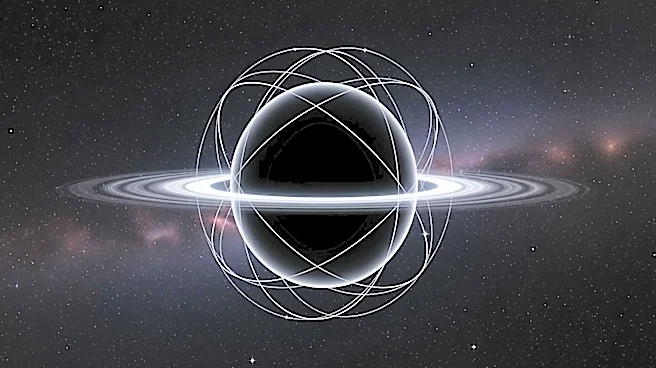
A new theory published in the Journal of Cosmology and Astroparticle Physics suggests that a mysterious neutrino detected in 2023 may have originated from a cosmic particle accelerator known as a 'blazar.' This neutrino, detected by a Mediterranean Sea-based
detector, carried an unprecedented amount of energy, sparking significant scientific interest. Blazars are a type of active galactic nucleus with a supermassive black hole at their center, emitting powerful jets of radiation. The theory posits that a cluster of interacting blazars could produce the high-energy neutrino observed, although the rarity of such detections suggests these events are uncommon.
Why It's Important?
The discovery of such a high-energy neutrino challenges existing scientific understanding of particle physics and cosmic phenomena. If confirmed, the blazar theory could provide new insights into the behavior of supermassive black holes and the mechanisms of cosmic particle acceleration. This research has implications for astrophysics, potentially leading to advancements in our understanding of the universe's most energetic processes. The study also highlights the importance of international scientific collaboration and the use of advanced detection technologies in uncovering cosmic mysteries.
What's Next?
Further research is needed to confirm the blazar theory and explore other potential sources of high-energy neutrinos. Scientists will likely continue to monitor for similar neutrino events and refine their models of cosmic particle acceleration. The findings may prompt the development of more sensitive detection equipment and inspire new theoretical work in astrophysics. As the scientific community seeks to unravel these mysteries, public interest in space exploration and particle physics may grow, potentially influencing future research funding and educational initiatives.