






What's Happening?
NASA has unveiled a 'Moon Base User's Guide' outlining the challenges it faces in executing 73 planned moon landings and establishing a permanent lunar base. The guide, published on April 6, details the agency's ambitious plans announced at the 'Ignition'
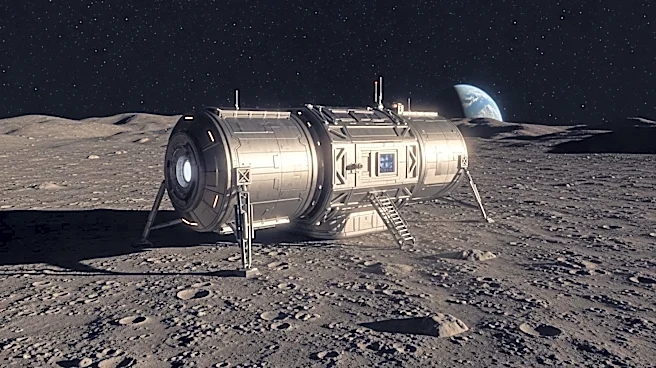
event on March 24. NASA aims to conduct 21 lunar landings within the next three years to lay the groundwork for a $20 billion moon base, with the first crewed missions expected by 2028. The document highlights gaps in current capabilities, including landing systems, habitation systems, and power systems necessary for human survival on the moon. NASA Administrator Jared Isaacman acknowledged the difficulty of these plans at the 2026 Space Symposium, emphasizing the agency's commitment to learning from potential failures.
Why It's Important?
The Moon Base User's Guide represents a significant shift in NASA's approach to lunar exploration, focusing on establishing a permanent presence on the moon. This initiative is crucial for advancing scientific knowledge and preparing for future missions to Mars. The ambitious plans are part of a broader strategy to maintain U.S. leadership in space exploration amid competition from other nations, notably China, which aims to land astronauts on the moon by 2030. The success of these missions could bolster the U.S. space industry, drive technological innovation, and enhance national prestige. However, the program's high costs and technical challenges pose risks to its feasibility and sustainability.
What's Next?
NASA plans to initiate a program to develop a mid-power space reactor with a lunar fission surface power variant ready for launch by 2030, as per a White House memorandum. The agency will focus on overcoming technological gaps, such as precision landing systems and robust power solutions, to support its lunar ambitions. The Artemis program will be retooled to include additional crewed lunar landings by 2028. As NASA works to address these challenges, the agency's ability to meet its ambitious goals will be closely watched by stakeholders, including government officials, industry leaders, and international partners.
Beyond the Headlines
The Moon Base User's Guide highlights the ethical and logistical challenges of long-term human habitation on the moon, including exposure to lunar dust, microgravity, and cosmic rays. These factors could impact astronaut health and require significant advancements in life support systems. The development of nuclear power systems on the moon is also crucial for future Mars missions, offering insights into deep space exploration. The guide underscores the need for international collaboration and technological innovation to achieve these goals, as well as the potential for new scientific discoveries and commercial opportunities in space.