


What's Happening?
The scientific community is engaged in a rigorous debate over the criteria for identifying biosignatures on exoplanets. A biosignature is typically a chemical or physical indicator that suggests the presence of life. However, the challenge lies in distinguishing
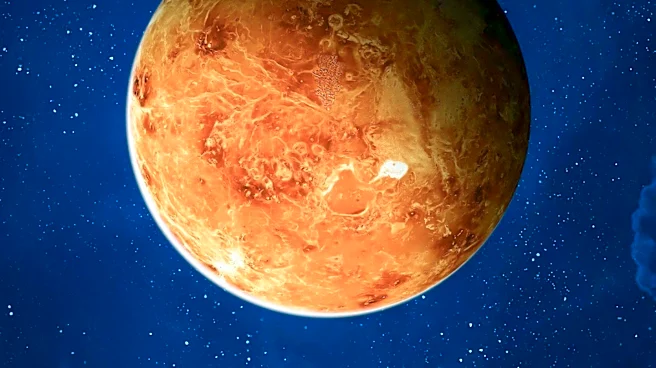
these signals from abiotic processes that can mimic biological activity. The article discusses the complexities involved in ruling out non-biological explanations for observed signals, emphasizing that a strong biosignature claim is built on the elimination of all plausible abiotic alternatives. The discussion includes historical cases such as the Viking landers' experiments on Mars and the detection of phosphine on Venus, highlighting the methodological challenges and the need for robust frameworks to assess potential biosignatures.
Why It's Important?
This debate is crucial as it impacts the search for extraterrestrial life, a field that holds significant scientific and philosophical implications. The ability to accurately identify biosignatures affects the allocation of resources in space exploration and the development of future missions. Misidentifying a biosignature could lead to false claims of life beyond Earth, affecting public trust and scientific credibility. Conversely, a confirmed biosignature would be a groundbreaking discovery, reshaping our understanding of life in the universe. The rigorous standards and frameworks being developed aim to ensure that any claims of extraterrestrial life are based on solid evidence, minimizing the risk of false positives.
What's Next?
The scientific community is likely to continue refining the criteria and methodologies for biosignature detection. Future space missions and technological advancements will play a critical role in providing more data and improving the accuracy of biosignature identification. Collaborative efforts across disciplines will be essential to develop comprehensive models that can better distinguish between biological and abiotic signals. As new data becomes available, the frameworks for assessing biosignatures will need to be updated to incorporate the latest scientific understanding.
Beyond the Headlines
The discussion around biosignatures also touches on broader issues such as the definition of life and the ethical considerations of space exploration. The lack of a universally accepted definition of life complicates the interpretation of potential biosignatures. Additionally, the risk of contamination—both forward and backward—poses ethical challenges, as it could compromise the integrity of scientific investigations. These considerations highlight the need for careful planning and international cooperation in space exploration efforts.