


What's Happening?
Physicists at the University of California San Diego have developed a novel method to verify the calibration accuracy of telescope polarization detectors. This innovation aims to distinguish between a potential cosmic rotation of cosmic microwave background
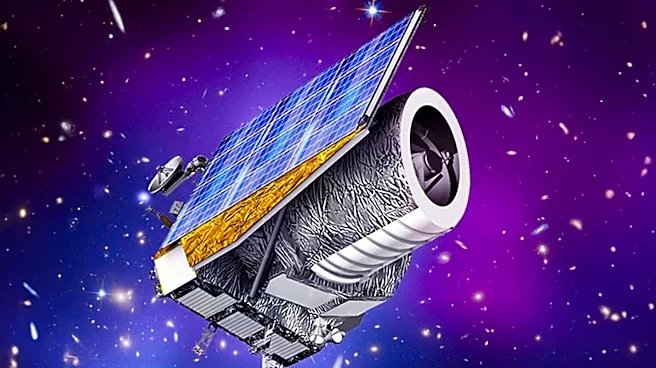
(CMB) polarization, known as cosmic birefringence, and errors caused by instrument misalignment. The method involves comparing separate polarization maps generated by different groups of detectors, rather than relying on a single combined map. If cosmic birefringence is real, its effect should appear identically across all maps. By comparing these maps, researchers can identify calibration differences between detector groups while isolating the common rotation signal. The method was successfully tested using data from the European Space Agency's Planck satellite, with results published in The Astrophysical Journal Letters.
Why It's Important?
This new method is crucial for accurately interpreting data from the early universe. The cosmic microwave background contains vital information about the universe's origins, and even slight errors in detector calibration can lead to misinterpretations of cosmological phenomena. Distinguishing between genuine cosmic signals and instrumental artifacts is paramount for scientific discovery. For instance, a small calibration error could transform a stronger E-mode signal into a false B-mode signal, potentially leading to an incorrect conclusion about the existence of primordial gravitational waves. By providing a robust way to detect and account for calibration errors, this research enhances the reliability of CMB observations, allowing scientists to draw more accurate conclusions about fundamental cosmological parameters and phenomena like cosmic birefringence.
What's Next?
While the new method cannot independently determine the overall polarization rotation angle, it significantly improves the ability to identify and correct relative calibration errors. Researchers combined their findings on relative errors with overall calibration values obtained through other methods, estimating the cosmic birefringence angle at 0.37 ± 0.12 degrees. Future applications of this method will likely involve its integration into the analysis pipelines of upcoming CMB experiments, such as those designed to search for primordial gravitational waves. By ensuring higher data integrity, this technique will help refine our understanding of the early universe and potentially confirm or refute the existence of subtle cosmological effects, pushing the boundaries of observational cosmology.
Beyond the Headlines
The development of this error detection method highlights the meticulous nature of modern astrophysics and the continuous effort to refine observational techniques. The ability to discern subtle cosmic signals from instrumental noise is a testament to the sophistication of current scientific methodologies. This work also underscores the collaborative nature of science, as U.S. researchers are building upon data from the European Space Agency's Planck satellite. Beyond its direct application to CMB research, the principles of comparing multiple independent measurements to identify systematic errors could be adapted to other fields of scientific inquiry where precise calibration and data validation are critical. It reinforces the idea that scientific progress often relies as much on improving measurement accuracy as it does on developing new theories.