




What's Happening?
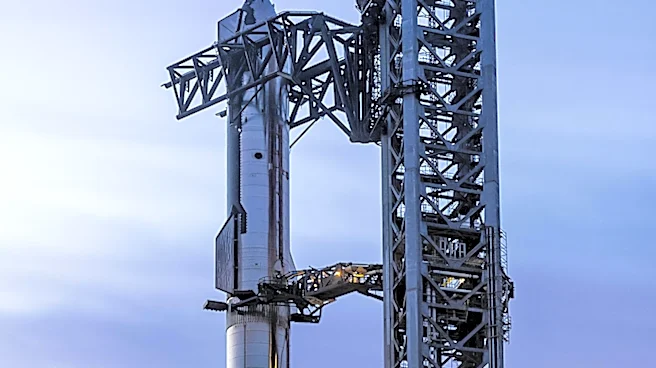
SpaceX CEO Elon Musk announced that the company will likely attempt the first-ever tower catch of Starship's upper stage, known as Ship, in 'a few months,' rather than the previously targeted late August. This update was shared via X, the social media
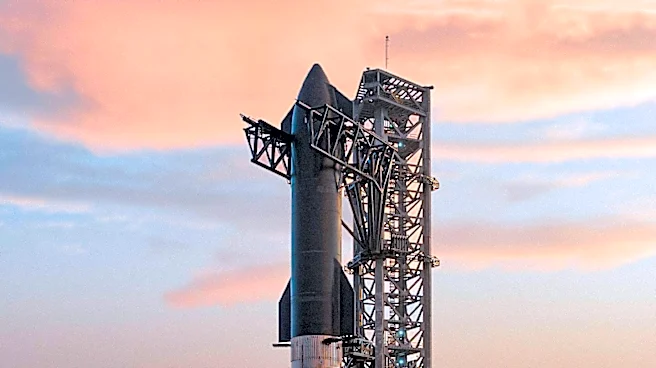
platform Musk owns. Initially, on August 4, Musk had indicated that the next test flight would include this ambitious maneuver. SpaceX has successfully performed 'chopstick' catches of the Super Heavy booster, Starship's first stage, on three of its 13 suborbital test flights, with two of those involving used boosters. However, catching Ship is considered more challenging due to its return from much greater heights and at higher speeds. Despite the delay, Ship demonstrated significant progress during Flight 13 on July 24, surviving reentry and splashing down intact in the Indian Ocean, a feat none of its predecessors achieved.
Why It's Important?
This delay in the Starship upper stage tower catch attempt is significant for the U.S. space industry and SpaceX's ambitious goals for rapid reusability. The ability to catch Ship with the launch tower's 'chopstick' arms is crucial for achieving the rapid and full reusability that SpaceX envisions for Starship, which is designed to be the biggest and most powerful rocket ever built. Full reusability is key to drastically reducing the cost of space launches, making missions to the Moon, Mars, and beyond more economically viable. A successful tower catch would be a major engineering milestone, demonstrating a critical capability for future space exploration and satellite deployment. The delay could impact SpaceX's development timeline and potentially affect the schedules of future missions that rely on Starship's full operational capability. The U.S. Federal Aviation Administration's regulatory approval is also a factor, suggesting that the timeline is not solely dependent on SpaceX's technical readiness.
What's Next?
SpaceX will continue to prepare for the Ship tower catch attempt, now anticipated 'in a few months.' This period will likely involve further analysis of data from Flight 13, additional testing, and securing necessary regulatory approvals from the U.S. Federal Aviation Administration. The next flight, Flight 14, is still expected to be Starship's first orbital attempt, a significant milestone in itself, even without the Ship catch. Elon Musk also indicated that the first reflight of Ship will occur either by the end of this year or early next year, which he described as a 'fork in the road of history for consciousness reaching the stars.' This suggests that while the tower catch is delayed, the overall development and testing of Starship will proceed, with a focus on achieving orbital flight and demonstrating the vehicle's capabilities for future deep-space missions.
Beyond the Headlines
The pursuit of full and rapid reusability for Starship, exemplified by the tower catch mechanism, represents a paradigm shift in space travel. This approach aims to transform space launches from an expensive, disposable endeavor into a more routine and cost-effective transportation system, akin to commercial aviation. The implications extend beyond mere cost savings; it could democratize access to space, enabling a wider range of scientific research, commercial ventures, and potentially even space tourism. The engineering challenges involved in catching a returning spacecraft with precision are immense, pushing the boundaries of aerospace technology. The success or failure of these attempts will not only impact SpaceX's trajectory but also influence the strategies of other space agencies and private companies globally, potentially accelerating the development of similar reusable launch systems and shaping the future of humanity's presence in space.