




What's Happening?
An international team of paleontologists from Stony Brook University, the Royal Ontario Museum, and the North Dakota Geological Survey has identified a new dinosaur species, *Infernogallus jamesi*, as the first known dinosaur to specifically consume fruit.
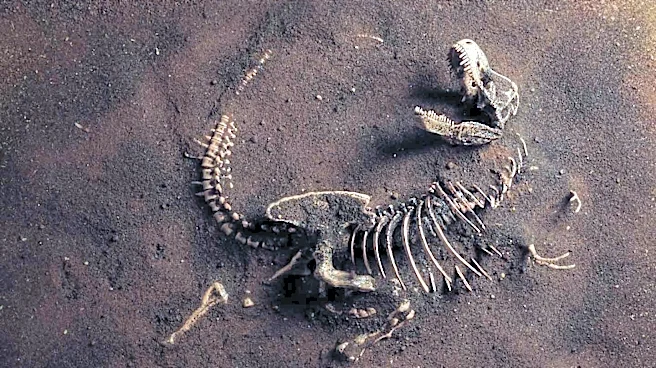
This small, bird-like, bipedal oviraptorosaur, nicknamed 'Hell Chicken,' lived during the Cretaceous period, approximately 145 to 66 million years ago. Its fossils, including a nearly complete skull and partial skeleton, were unearthed in the Hell Creek Formation, a geological area spanning Montana, North Dakota, South Dakota, and Wyoming. Led by Greg Funston, an assistant professor at Stony Brook University, the research analyzed the dinosaur's chewing muscles and palatal bones, revealing unique adaptations for mashing soft foods. Unlike the rigid vertical bite of carnivorous dinosaurs like T. rex, *Infernogallus* possessed a chewing motion where its beak slid back and forth, similar to modern fruit-eating parrots and humans. This discovery challenges previous assumptions about dinosaur diets and their interaction with the evolution of flowering plants.
Why It's Important?
The discovery of *Infernogallus jamesi* is significant because it provides unprecedented insights into the dietary specialization and evolutionary adaptations of dinosaurs. Previously, paleontologists had struggled to establish clear links between dinosaur diversity and the evolution of flowering plants. This finding suggests that some dinosaurs played a role in the ecosystem as seed-dispersers, a function primarily attributed to birds, reptiles, and small mammals today. The unique chewing mechanics of *Infernogallus*, with its forward-facing muscles adapted for processing soft fruits, highlights a remarkable evolutionary parallel with modern fruit-eating species. This specialization indicates that as fruits became more common and larger during the Cretaceous period, certain dinosaur groups, like the caenagnathids, evolved to exploit this new food source. The presence of such a specialized fruit-eater alongside large carnivores and herbivores in the Hell Creek Formation enriches our understanding of the complex food webs and ecological niches that existed during the late Cretaceous.
What's Next?
The discovery of *Infernogallus jamesi* opens new avenues for paleontological research. Future studies will likely focus on further analyzing the anatomical adaptations of this species and its relatives to understand the full extent of their dietary specializations. Researchers may also investigate other fossil sites for similar evidence of fruit-eating dinosaurs, potentially uncovering more species with unique feeding strategies. The findings could prompt a re-evaluation of the impact dinosaurs had on the co-evolution of flowering plants, leading to a deeper understanding of ancient plant-animal interactions. Additionally, the ongoing study of the Hell Creek Formation, a rich source of Cretaceous fossils, may yield further surprises about the diversity and behavior of dinosaurs that coexisted with *Infernogallus*, T. rex, and Triceratops.
Beyond the Headlines
This discovery extends beyond a mere identification of a new species; it fundamentally alters our perception of dinosaur ecology and evolution. The idea of a 'hell chicken' thriving on fruit in an environment dominated by formidable predators like T. rex underscores the incredible adaptability of life. It highlights that even within seemingly well-understood groups, there can be unexpected dietary and behavioral diversity. The unique chewing mechanism of *Infernogallus*, resembling that of humans and certain parrots, offers a fascinating case study in convergent evolution, where different species develop similar traits independently to solve similar environmental challenges. This finding also prompts ethical considerations regarding the preservation of fossil sites, as each new discovery can dramatically reshape our understanding of prehistoric life and the intricate web of ancient ecosystems. It emphasizes the continuous nature of scientific discovery and the vast amount we still have to learn about Earth's ancient past.