







What's Happening?
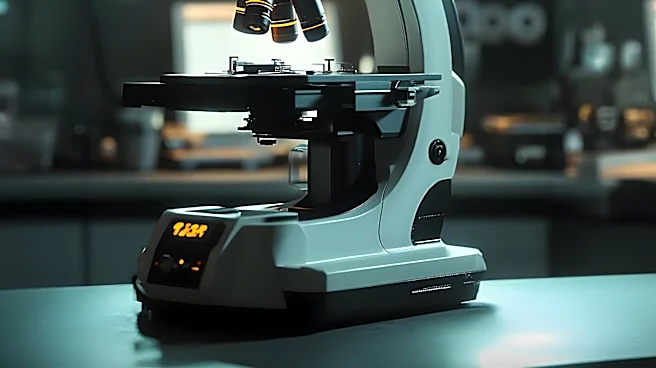
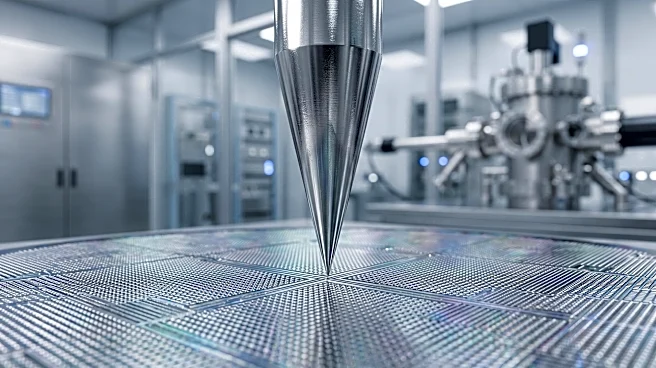
A joint research team at POSTECH, led by professors Junsuk Rho and Chulhong Kim, has developed a groundbreaking dual-focus metalens-based photoacoustic microscopy system. This new system can switch between different imaging depths by simply adjusting
an applied voltage, thereby eliminating the need for mechanical movement of optical components. Traditional optical microscopes face challenges in maintaining sharp focus across varying depths, similar to how a camera struggles to focus on both near and distant objects simultaneously. The tighter the focus, the narrower the depth range. This innovative metalens technology addresses this limitation by offering a more dynamic and efficient way to adjust focus, as detailed in their study published in Light: Science & Applications.
Why It's Important?
This technological advancement has significant implications for U.S. industries, particularly in medical imaging, scientific research, and manufacturing. By removing the need for mechanical moving parts, the metalens microscope can achieve faster, more precise, and potentially more robust focusing capabilities. This could lead to more efficient and accurate diagnostic tools in healthcare, enabling clearer imaging of internal body structures at various depths without invasive procedures. In scientific research, it could accelerate studies requiring multi-depth imaging, such as neuroscience or materials science. For manufacturing, it could improve quality control processes that involve inspecting complex, three-dimensional components. The reduced complexity and increased speed could also lower the cost and maintenance requirements of advanced microscopy systems, making them more accessible.
What's Next?
The immediate next steps involve further research and development to optimize the metalens system for broader applications and potentially scale up its production. Researchers will likely focus on improving the resolution, expanding the range of tunable depths, and integrating the technology into existing microscopy platforms. Potential reactions from major stakeholders include increased investment from medical device companies and research institutions looking to adopt this more efficient imaging technology. The development could also spur competition among optical component manufacturers to develop similar voltage-controlled focusing solutions. Long-term, this innovation could pave the way for entirely new designs of optical instruments that are more compact, durable, and versatile.
Beyond the Headlines
The development of voltage-controlled metalenses represents a fundamental shift in optical engineering, moving away from traditional mechanical systems towards electronic control. This paradigm shift has profound implications for how we design and interact with optical devices. It could lead to the miniaturization of complex optical systems, enabling their integration into smaller, more portable devices. Ethically, improved medical imaging capabilities could lead to earlier and more accurate diagnoses, potentially saving lives and improving patient outcomes. Culturally, this innovation underscores the ongoing human quest to see and understand the world at increasingly finer scales, pushing the boundaries of perception and knowledge. It also highlights the interdisciplinary nature of modern scientific breakthroughs, combining physics, materials science, and engineering.